Waikato farm a role model for riparian planting
A Waikato dairy farm which began its first riparian planting project 20 years ago now stands as an exemplar for rural land users, backed by science and clever long-term planning.
 increase font size
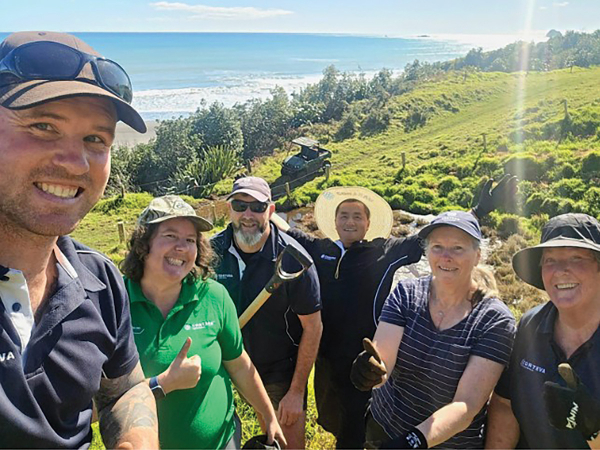 The Waireka team after a morning of planting onsite.
For more than 50 years, Waireka Research Station at New Plymouth has been a hub for globally important trials of fungicides, insecticides and herbicides, carried out on 16ha of orderly flat plots hedged for protection against the strong winds that sweep in from New Zealand’s west coast.
But 2025 has seen a new focus for staff working at Corteva Agriscience’s global discovery site – the rehabilitation of several hectares of steep hillsides and natural wetlands between the research station and the coast, to restore habitat and boost biodiversity.
Waireka Research Centre leader, Tania Gunn, said plantings on such steep slopes have required a team effort from all staff.
“Due to the steepness of the site we have to plant by hand, so in September the whole team, six people including scientists, researchers and admin staff, hiked up and down the hills together planting out 250 seedlings,” Gunn said.
“That’s around 15-205 of the total area we aim to rehabilitate with coastal plant species such as New Zealand flax, corokia and karaka, and we’re hoping to scale up even more in 2026 with another 1500 plants on order.”
Riparian planting is the process of establishing native vegetation along riverbanks and other waterways to protect and rehabilitate the area. It is a common requirement for New Zealand farmers to ensure sensitive areas are protected, to stabilise the banks of small streams, improve water quality and enhance biodiversity.
The New Plymouth District Council provides discounted plants that are ordered a year in advance, and the farm managers on Waireka clear the site of grasses and lay out the seedlings prior to sowing.
The Waireka site receives more than 1200mm of annual rainfall and features volcanic soil types, a legacy of nearby Mt Taranaki. After 20-plus years of grazing, the exclusion of stock from three significant areas of farmland is part of the plan to allow the wetlands to recover.
The project has also required the support of local iwi and hapu (tribes & subtribes), as areas of the farm are SASM (Sites and Areas of Significance to Māori) and wahi tapu (sacred), and contain several sites of archaeological importance.
“We have built partnerships with local iwi and hapū over several years to ensure our plans respect cultural values,” Gunn said.
“This ongoing communication and feedback culminated in a consent application After 20- plus years of grazing, the exclusion of stock from three significant areas of farmland is part of the plan to allow the wetlands to recover. to the local council, supported by iwi.
“Due to needing to fence stock out of the riparian areas, local Hapu representatives from Ngati Tairi were present for the ground disturbance of putting in fence posts.”
Future Plans
Another challenge awaits, to protect the new plantings.
“The sites require regular maintenance to prevent damage from rabbits, a type of swamphen we call pūkeko, and overgrown grass,” Waireka Research Centre leader, Tania Gunn said.
“It’s too soon to see any change, but we would anticipate that the next three years of planting will bring results. Hopefully, we’ll see more native fish in the stream that runs through the Research Station and attract coastal bird life such as black billed gulls and fantails.
“For Corteva Agriscience and the Waireka Research Station, riparian planting is part of our commitment to sustainable land management. And restoring native plants to the site was a fun and rewarding way to connect as a team.
“Next year we have 1500 plants on order, so we’ll be expanding an offer to the wider NZ team to help us get them in the ground.”
A Waikato dairy farm which began its first riparian planting project 20 years ago now stands as an exemplar for rural land users, backed by science and clever long-term planning.
When planning a project it is important to be clear what current conditions exist, what information you need to collect to determine this and importantly a clear understanding of the goals you wish to achieve.



Now in its fourth year, the 2026 Fencing Industry Awards, formed part of the proceedings of the FCANZ Conference, held in Nelson during August.
DairyNZ deputy chair Cameron Henderson has been re-appointed unopposed for another term.
OPINION: The stats speak for themselves.
Farms across the upper North Island are trialling different pasture mixes as part of a research programme that aims to build greater resilience into farming systems.
Election years are always a concerning time for farmers, according to DairyNZ chair Tracy Brown.
The Ballance Farm Environment Awards are coming to the West Coast of the South Island.