UK Politician Alistair Carmichael Praises "Positive Spirit" of NZ Farmers
A leading British farming politician says he's impressed with the positive attitude of New Zealand farmers that he met during his recent trip here.
 increase font size
 Is it wise to place all our eggs in what appears to be a very leaky digital basket?
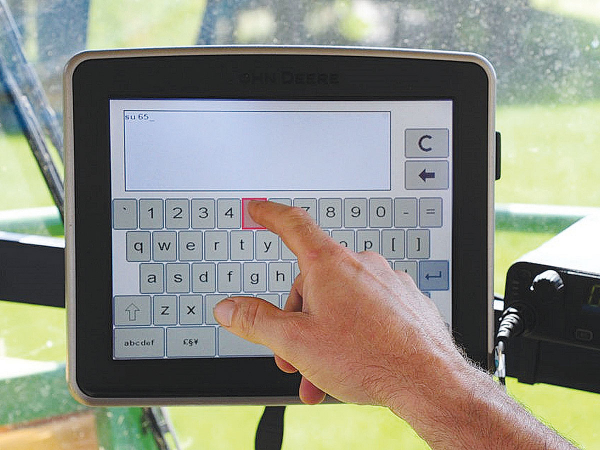
OPINION: As agriculture continues its march into the digital age - where farmers, paddocks, machines and inputs are all interconnected - one must wonder whether an individual or organisation could wreak havoc if they broke into operating systems.
A hacker at a recent conference in Las Vegas demonstrated his ability to get the 1993 video game Doom to play on a John Deere 4240 tractor control console. This latest hack follows a ransom-ware attack on AGCO - the manufacturer of brands such as MF, Fendt and Valtra - in May, that affected production, parts support and invoicing for up to two months.
John Deere, a leader in bringing digital technology to the farm, said the hack on its tractor was restricted to one machine and didn't pose any threat to the company's overall system. However, it is an embarrassing reminder that electronics remain vulnerable to outside interference.
Industry advisors point out that the JD company relies on what is considered outdated software to run the onboard systems. Chief among these is Windows CE, that is licensed to OEM's and will see support withdrawn in 2023.
In a telephone interview, the hacker ('Sick Codes') noted that he set out to investigate the vulnerability of the whole food supply chain infrastructure, because nobody else was doing so. He was not reassured by what he found.
Although there appears to be only one hacker bringing this to our attention, his ability to run an early version of Doom software on a consul that we are told is totally secure, suggests there may be an underlying problem. The fact that he was able to get around the software locks installed by John Deere's engineers should make any existing, or potential users, of such systems a little wary. As the demonstration showed, entry into systems and code changes are possible.
Installing and running software that comes from the early 1990s, as does Linux and Microsoft CE, enables the less tech-savvy to visualise the age of the software upon which many systems rely.
Those same insiders also claim that JD has incorporated open licence software into its operating systems and that by doing so it is contractually bound to make it public. Correct or not, it suggests that JD might be at risk of legal action for not complying with licence agreements - most likely from those fighting for the right to repair their own machines.
Of course, John Deere has been active in promoting digitisation, but at the same time, defending the practice of restricting the repair of tractors to its dealers, refusing external, non-authorised access to farmers or DIY mechanics.
Yet, JD is unlikely to be the only company that has this sort of software at the core of its systems and other manufacturers must be watching developments with alarm.
Given that 'Agriculture 4.0' is being touted as the digital roadway to transform farming into a data-driven and automated provider of food for the burgeoning population over the next decase, is it wise to place all our eggs in what appears to be a very leaky digital basket?
A leading British farming politician says he's impressed with the positive attitude of New Zealand farmers that he met during his recent trip here.

Last month's National Fieldays was an important event for Canadian manufacturer Can-Am, as it unveiled its first electric ATV, the Outlander, adding extra option to the new Defender HD11 and Defender MAX HD11 line-up.
New Zealand rural apparel brand Back Country is inviting Kiwis to part ways with tired, holey socks at Fieldays with a giant 'Sock Swap Fence' inspired by one of New Zealand's iconic rural roadside landmarks.
OPINION: The old saying 'a new broom sweeps clean' doesn't always hold up, if you ask the Hound.
More than 1200 exhibitors will showcase their products and services at next month’s National Fieldays, with sites nearly sold out.
Election years are always a concerning time for farmers, according to DairyNZ chair Tracy Brown.
The Ballance Farm Environment Awards are coming to the West Coast of the South Island.
Most dairy regions around the country have had a pretty good season so far says Tracy Brown.
Rural leader Mark Hooper has been appointed as an independent director to the NZPork board, bringing extensive farming, governance and advocacy experience to the role.
Opportunity says its land value tax (LVT) is unlikely to force farmers into a position where asset sales or increased debt are required.
Milk powder prices are keeping farmgate prices up, helping processors offset the dip in milk fat prices.