NZ exports to EU surge by $3b under free trade deal, says Government
New Zealand exports to the European Union have surged by $3 billion in two years under the New Zealand-European Union Free Trade Agreement.




 increase font size
 Nathan Penny.
Beef and lamb exports paint two different pictures, according to the ASB’s Farmshed Economics report for August.
ASB rural economist Nathan Penny says the rise in lamb prices in August is normal for this quiet time of the season. And because the New Zealand dollar went largely sideways during the month, the lift is similar in NZD and foreign currency terms.
“But putting aside seasonal factors and the earlier NZ dollar fall, nothing much is doing in lamb markets. The same recent drivers of the price weakness are still in play,” Penny adds.
“Lamb supply, in particular, continues strong, pushing down prices. Strong domestic production in the key UK and Chinese markets has increased lamb (and sheep meat) supply. Supply has been similarly high here in NZ and in Australia.
“All up, we expect underlying lamb prices (in foreign currency terms) to remain weak over the next few months, particularly relative to a year ago.”
However, Penny says with further NZ dollar falls and the normal seasonal lift in prices may lead to a modest lift in farmgate prices.
Meanwhile, the ASB says records continue to tumble for beef prices.
“Over the July-August, the beef index has lifted a further 7%, setting fresh record highs. However, a potential price ceiling is emerging. It is likely that NZ will fill its US quota earlier this year, compared to last. This means average export prices may fall or plateau as meat companies are forced to divert beef to other lower-paying markets over coming months.
But whether this will translate into lower farmgate prices is less clear.
“Some meat companies may still have their share of quota in hand. As a result, robust local competition for beef is likely to keep prices strong. Either way, beef prices are likely to stay high over the coming months, though the current stratospheric prices may give way to merely sky-high ones. With that in mind, the outlook for the beef sector remains very positive.”
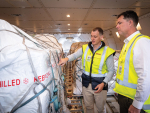
New Zealand exports to the European Union have surged by $3 billion in two years under the New Zealand-European Union Free Trade Agreement.

A Hawke's Bay apple orchardist supports the Government's objective of doubling exports but says this won't happen in the horticulture sector unless there's a change in the process for bringing new plant material into the country.
Horticulture New Zealand (HortNZ) says a new report projects strong export growth for New Zealand's horticulture sector highlights the industry's increasing contribution to the national economy.
Global trade wars and uncertain tariff regimes could play into the hands of many New Zealand exporters, according to Gareth Coleman ANZ’s Head of Trade & Supply Chain.
A new Indonesian school milk programme is expected to significantly increase the country's total dairy consumption, creating opportunities for New Zealand and other global dairy players.


OPINION: For thousands of Southland farmers, this week would have tipped them into the non-compliant category when it comes to following regional freshwater plan rules. But the Government has stepped in to give them the clarity they deserve.

The stark realities of the world trade that New Zealand is having to face have been revealed by Trade Minister Todd McClay.
New Zealand and the European Union are closer than ever.
The latest data from the Real Estate Institute of New Zealand (REINZ) reveals a mixed rural property market due to consistent inflation concerns.
Animal welfare improvements as well as reduced costs for dairy farmers are at the heart of a new move which could help cut back on the waste of unused vet drugs.
Developing pasture species that enable farm animals to produce less biogenic methane and nitrous oxide is a critical tool in NZ's quest to reduce greenhouse gas emissions (GHGs).


OPINION: The old saying 'a new broom sweeps clean' doesn't always hold up, if you ask the Hound.
OPINION: This old mutt went to school to eat his lunch, but still knows the future of the country, and…