NZ kiwifruit sector on alert for mysterious Italian disease
New Zealand's kiwifruit industry is on alert following reports of a mystery disease that is sweeping through Italian orchards.




 increase font size
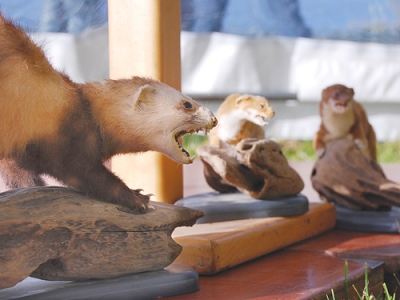 Rogues Gallery: A trio of stuffed muscelids - ferret, left, weasel and stoat - strike a pose at the base of the lectern before the official opening of the new ZIP predator research enclosure at Lincoln.
Predator proof fencing made more attractive for the agriculture industry is a goal of a new predator research facility near Lincoln, Canterbury.
The 2ha enclosure is the work of Zero Invasive Predators Ltd (ZIP), with funding from Fonterra, Synlait, Tatua, Open Country, Westland and Miraka.
This 200 x 100m field, ringed with high, escape-proof fencing, is a secure testing ground for a range of rat, stoat and possum control technologies.
Officially opened on June 9 by Conservation Minister Maggie Barry, it is already producing promising results, such as new stoat traps using lures made of oestrus bedding material from stoats on heat. ZIP's tests showed that 90% of stoats seemed attracted to the new traps versus 50% for conventional food-baited traps.
A feature of the enclosure is a cross-fence dividing it in two but with a 20m-wide open channel in the middle, mimicking the openings in predator-proof fences that may be needed for roads, streams or stock races on farms.
Animal behaviour technician and field ranger Tim Sjoberg will use the channel to test technology such as electrified cattle stops, ultrasound and lighting to deter predators from going through the crossings.
Sjoberg says they plan to test an electrified grid similar to a cattle stop, but experience with electric fences shows that some animals learn to get through by "hitting them at speed" so a focus will be on slowing the predators by means such as bright lights at their eye level, sound and images of other predators.
Another trial is underway on a small square pen made of a low predator-proof fence. Like the facility's main perimeter fence, it is capped with a galvanised-steel inverted gutter that predators cannot climb over, but at about 80cm high it is being used to find out how low a fence can be made while remaining effective.
Animal behaviour technician Tom Agnew says the idea is to make predator-proof fencing more "saleable" to farmers. Fences closer to the standard stock fence height would interfere less with farm practices and would be better looking and cheaper.
The company is also testing a new pitfall trap for stoats, and automated trap detection devices to alert trappers when a predator is caught, to allow cheaper and more efficient trapping.
ZIP says traps which automatically empty and reset themselves after a kill are proving popular and effective, but their lures get stale over time, so another project is to develop dispensers which automatically refresh the bait.
ZIP has moved quickly since it was formed in February 2015 as a charitable R&D entity supported by DOC and the NEXT Foundation, and money from Gareth Morgan's Morgan Investments and Sam Morgan's Jasmine Social Investments.
It began with an ambitious vision "to ensure the long-term resilience of New Zealand's biodiversity by completely removing rats, stoats and possums from large areas of the mainland, and keeping them out."
ZIP runs a field research facility at Bottle Rock Peninsula, Marlborough Sounds. NZ's top dairy companies are helping fund the Lincoln research enclosure, largely because the industry needs to combat possum-spread tuberculosis.
Conservation Minister Maggie Barry, opening the new facility, says NZ has to become a world leader in invasive species control.
"We were a land without teeth for millions of years so our birds and creatures are ill-equipped to deal with these cunning toothed predators whose main aim in life is to eat the [the others].
"We have to kill them before they kill the things we love. Rats alone are estimated to kill around 26 million bird chicks and eggs every year."
ZIP business manager Phil Bell says the company wants to take the know-how already developed in making some islands pest-free and apply it on a much bigger scale to areas of the mainland.
New Zealand's kiwifruit industry is on alert following reports of a mystery disease that is sweeping through Italian orchards.

Could automated gun turrets in the bush shooting predators with poison paintballs rid the country of introduced pests?
As mealybugs gain a foothold in Central Otago, grapegrowers are being urged to be vigilant for signs of Grapevine Leafroll-associated Virus Type 3 (leafroll 3) in vines.
An invasive weed that can reduce water quality and block irrigation systems has been discovered in the Waikato River.
For strong wool sheep, lice infection is a nuisance more than a hefty financial cost. But, for fine wool sheep the financial toll is much greater.


Safer Farms is urging farmers to make sure everyone working on farm has safe, suitable footwear for the job.

The Government is backing work on a community-led water storage scheme that could irrigate up to 11,000 more hectares of the Poverty Bay flats, Agriculture Minister Todd McClay says.
Agri-tech company Herd-i has become a new all-region sponsor of the New Zealand Dairy Industry Awards (NZDIA), the largest nationwide celebration of excellence in the dairy sector.
Four candidates have been confirmed for two director positions on Fonterra’s board.
Returning to the family dairy farm after playing 20 years of professional rugby around the world is no easy task.
After delivering another record farmgate milk price to 100 supplying farms, independent milk processor Tatua is entering thee new financial year with a positive outlook.




OPINION: The same mainstream media muppets that brought you Jacindamania in 2017 have been flat out pimping for the Opportunities…
OPINION: Your old mate reckons the atrocious way farmers in the UK are treated by their lords and masters in…




