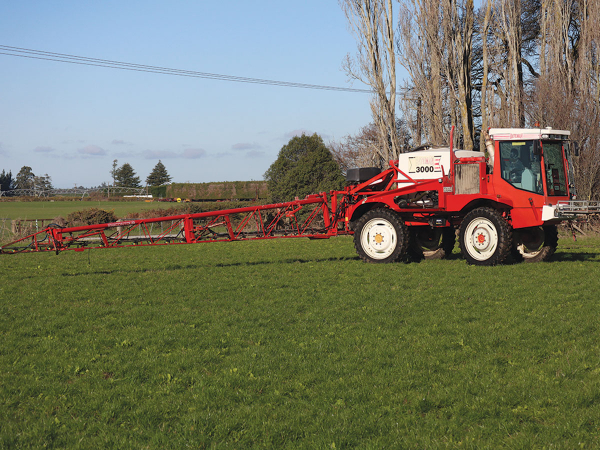
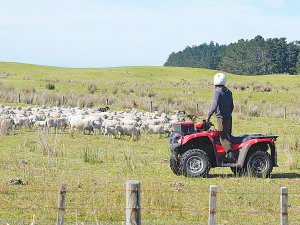
Donaghys are passing on advice for spray contractors who will be applying its patented formula N-Boost on dairy pastures this season.
With the price of nitrogen fertiliser at historic highs, the company says that more dairy farmers have been turning to liquid application of urea with N-Boost to realise potential cost savings and maximise pasture production.
N-Boost is a patente formulation that contains adenine compound and amino acids. It is added to dissolved urea and foliar sprayed onto pasture and crops.
For farmers and contractors this can be a mindset-shift from applying solid fertiliser, and there are some rules of thumb to ensure it is applied for optimal results according to Donaghy's general manager crop protection and export, Tim O'Sullivan.
"Since we ran our farmer field days in Autumn on our demonstration farms in the Waikato, Canterbury and Southland we have been meeting with rural spray contractors due to the lift in enquiries for N-Boost," he says.
"We had over 200 farmers, farm advisors, rural bankers and spray contractors attend these events. It was of interest to spray contractors who want to keep up to speed with sustainable solutions for how dairy farmers are farming under nitrogen cap regulations."
The N-Boost System, designed for application on pasture, is 40 kg/ha of urea dissolved in water with 3 L/ha of N-Boost, typically sprayed at 200 L/ha. Urea is easily dissolved in water in an N-Boost Mixing Station or by agitating in a spray tank.
"Farmers are generally employing contractors to apply N-Boost across the grazing platform, in spring, and autumn.
"For a spray contractor this makes it a good block of continuous work for a spray unit. You're on one site spraying an easy to mix and apply product."
O'Sullivan says the system relies on timing of application.
"The application system differs from traditional applications of solid urea, where you can follow the round directly after the cows, and the urea can sit on the soil surface until it's watered in.
"N-Boost acts as a stimulant for the plant to enhance its ability to utilise all plant available N in liquid urea. Relying on leaf area coverage by conventional sprayer application, you don't want to apply right after grazing - you want to apply right after grazing - you want the grazz to have recovered and be growing so it can take on that N."
Tim says it can also be applied with a number of other liquid chemicals including commonly used herbicides, fungicides and pesticides.
Tips for Applying N-Boost
- N-Boost should only be used when a nitrogen response can be expected
- Soil temperatures must be 10 °C or above
- Ensure sufficient pasture cover for optimum foliar uptake (1400-1600kg DM/ha)
- For best results apply the N-Boost System 3-5 days after grazing
- Sufficient soil moisture content is required for pasture to respond
- Avoid application in very hot conditions as it can lead to plant scalding
- Avoid windy conditions or within 6 hours of impending heavy rain as the N will not be taken up through the leaf.