The managing director of Fonterra Brands Thailand, Paul Richards, says the country’s maturing economy and growing urban middle class presents the co-op with a huge opportunity. Thailand’s population is at least 67 million.
“Thailand’s transition from an agriculture-based economy into a knowledge-and-skills-based economy has led to an increasingly urban and affluent population, which is… eating out of home and on-the-go more often”.
While Thailand’s overall dairy consumption is still relatively low (26.6L/person/year) compared to Singapore (61L) and New Zealand (272L), it is much higher than many other Southeast Asian markets and is growing rapidly.
Thailand has traditionally been a milk powder, condensed milk and evaporated milk market, Richards says. The co-op has sold WMP, SMP, BMP and AMF to Thailand since the 1950s.
“Today we’re [meeting] increasing customer demand for cheese, UHT and pasteurised ready-to-drink milks, drinking yoghurt, yoghurt and flavoured milks.”
NZMP South and East Asia regional account manager Kimble Willis says the co-op is selling higher value ingredients such as protein, cheese and powders into the strongest growing dairy segments.
“Customers are increasingly demanding specific benefits in their ingredients…. For example, in sweet whey powder we have created additional testing and specification limits in our NZ facilities to meet Thailand’s regulations and match customers’ applications.”
Richards says there is huge potential in value-added dairy products as more Thai consumers with higher incomes demand greater variety, convenience and western-influenced options.
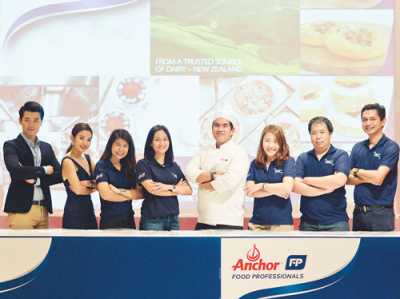
“We’ve been capitalising on the trend of increased mobile dining. Our foodservice business Anchor Food Professionals sells dairy products to 3500 food and beverage outlets across the country each year.”
Convenience stores sell about one third of all fast-moving consumer goods in Thailand; the number of stores is forecast to grow at 12% each year until 2020.
“This is a channel we’re focused on,” Richards says. “With strong brand presence in this channel we’ve been able to expand our geographic footprint into large towns and tourist areas quickly.
“We’re partnering with key convenience stores to develop new menus and products.”
For example, the co-op worked with 7-Eleven to create Carbonara Sandwich and Chocolate Toasties, and launched two new flavours of Anlene Gold UHT and Anmum UHT milk for the first time in 7-Eleven. The 7-Eleven listing resulted in a 56% growth in UHT sales in 2016 versus 2015.
The co-op says rising incomes and better education have led to an increased awareness about the nutritional benefits of dairy, hence the co-op growing its advanced nutrition category, which contains the Anlene and Anmum brands.
Anmum is said to hold the number one position in the market, maintained through new formulation and product developments. For example, Anmum’s latest formulation Anmum Materna Probiotics DR10, which supports the digestive system, was developed after speaking to pregnant women concerned about constipation.
Recent new Anlene flavours have included UHT English Malt and Spring White Tea.