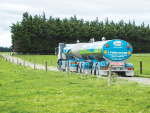
Fonterra FY26 Results: $9.69 Milk Price, $3.4bn Profit
Fonterra has unveiled its annual results for the 2026 financial year, posting $27 billion in revenue and close to $20 billion returned to New Zealand farmer owners and unit holders.
 increase font size
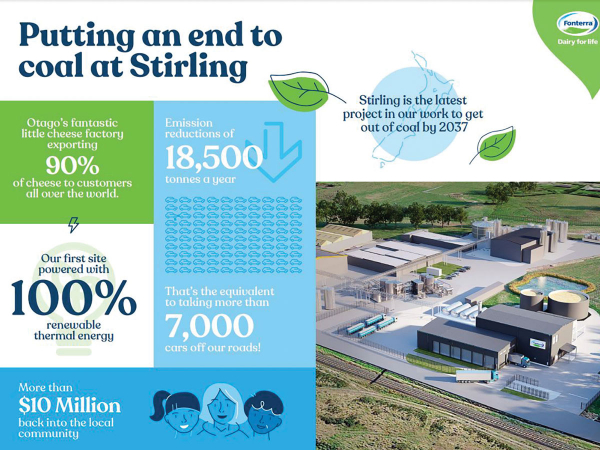 Fonterra says its Stirling cheese plant will switch from coal to wood biomass from August next year.
Fonterra's Stirling plant in Otago is to become coal-free by August next year.
By switching to wood biomass, the cheese plant's annual emissions will reduce by 18,500 tonnes of carbon dioxide - the equivalent of taking more than 7,000 cars off the road.
This will make Stirling Fonterra's first 100% renewable thermal energy site, a significant step towards the co-operative's goal of getting out of coal altogether by 2037.
Fonterra general manager operations Lower South Island, Richard Gray, says it's another huge decarbonisation milestone for the co-op.
"Sustainability is at the heart of our strategy and this project is something that will be good for the environment and local community. As well as the site being coal free, there are additional environmental benefits the new boiler will bring, including reduction in wastewater, noise, solid waste to landfill and air discharge emissions."
He also cites economic benefits for the community, including more than $10 million for the region, and an estimated 10 jobs in the wood biomass industry.
“Our Stirling site exports to customers in more than 10 countries, including Japan and South Korea, and we’re looking forward to sharing this news with them also.”
The wood biomass will be provided by Pioneer Energy, which is locally owned by Central Lakes Trust. The Trust distributes grants to charitable causes in the Central Otago region.
Pioneer Energy chief executive Fraser Jonker says it is very proud to be involved with and to support Fonterra’s move from coal to biomass in Stirling.
“Pioneer has a proven record for the installation of new, and conversion of existing, boilers to biomass, and with our own wood fuel division assuring quality and security of local supply for the fuel, have mitigated any perceived risk of making this very important transition to a low carbon future.”
Stirling is the third significant fuel switching project the co-op has undertaken in as many years. The conversion of Fonterra’s Te Awamutu site to wood pellets has resulted in a 10% reduction in the co-op’s coal use, and at its Brightwater site, at the top of the South Island, it is co-firing wood biomass.
Fonterra says these three projects, when combined with other energy efficiency work, will reduce its emissions by 135,000 tonnes, the equivalent of taking close to 52,000 cars off the road.
Eight of Fonterra’s 29 sites are still using coal.
Fonterra’s Stirling announcement came as Minister for Energy and Resources, Megan Woods, officially opened Fonterra’s wood pellet boiler at its Te Awamutu plant last week.
Fonterra has unveiled its annual results for the 2026 financial year, posting $27 billion in revenue and close to $20 billion returned to New Zealand farmer owners and unit holders.
Fonterra Co-operative Group has confirmed the independently assessed candidates standing for election to its board in 2026.
Fonterra has revised its Farmgate Milk Price forecast for the 2026/27 season, lifting the midpoint and narrowing the range on the back of improving global dairy commodity prices.
Outgoing Fonterra Co-operative Council chair John Stevenson says that it has been a privilege to represent the co-op's farmer shareholders.
OPINION: It seems Canterbury processor Synlait is still in the doldrums.


Farmers across parts of Southland and South Otago are continuing to deal with difficult conditions after a prolonged run of wet weather, with pressure building around feed supply, stock management, pasture damage, farm infrastructure and everyday workloads.
Federated Farmers says it welcomes Labour's commitment to reviewing the Sharemilking Agreements Act, calling on other major parties to do the same.
For Canterbury dairy farmers Sian Meijer and Rick Wobben, wearable technology has become one of their most valuable on-farm tools - helping manage 1850 cows across an expansive, high-performing dairy operation while improving efficiency, mating outcomes and day-to-day decision making.
Fonterra has unveiled its annual results for the 2026 financial year, posting $27 billion in revenue and close to $20 billion returned to New Zealand farmer owners and unit holders.
The first major update to the Dairy Cattle Code of Welfare in more than a decade has been released, marking what DairyNZ describes as an important step in ensuring animal welfare standards continue to evolve alongside scientific evidence and on-farm realities.
Ravensdown shareholders have elected Jane Montgomery and Kate Acland to the Ravensdown Board for three-year terms, following a closely contested director election.