What Would Synlait Be Worth to Fonterra or a2 Milk?
Speculation of a possible joint move by Fonterra and a2 Milk to buy Synlait raises a much bigger strategic question, says agribusiness expert Dr Nic Lees.
 increase font size
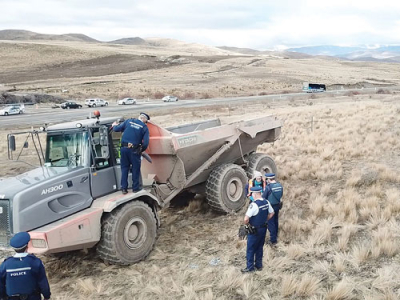 Police officers remove protestors from the Mackenzie Basin farm.
Greenpeace protests and opposition from Fonterra are not affecting Dunedin businessman Murray Valentine’s plans for a large state-of-the-art dairy conversion in the Mackenzie Basin.
The Simon’s Pass conversion remains on track to begin milk production on newly irrigated pasture in the coming season.
“We’ve been saying for a while that our strong preference is for no further expansion in the Mackenzie Basin because we’re concerned it will have a negative impact on the region’s sensitive environment,” said Miles Hurrell, chief operating officer of Fonterra’s Farm Source.
“However, under the current Dairy Industry Restructuring Act, we are required to accept applications to supply us from farms within our collection zone. Before we pick up their milk the farms would need to have all required environmental consents.”
Valentine said he was meeting the terms of his consents and did not want to comment further on Fonterra’s position.
“They’ve agreed to take the milk and I think I’d just leave it at that,” he said.
“It’s their decision to take whatever view they want to. I really can’t comment any more on what they’re saying.”
The property is 9600ha -- about 5500ha in pastoral lease and the balance freehold -- straddling State Highway 8 just south of Lake Pukaki.
Under the conditions of his consents agreed to through the Environment Court, Valentine will put about 40% of the property into a conservation area. Much of the rest will be irrigated by a pipeline now under construction, bringing water 8km down the side of the lake from the Tekapo canal.
Although he has resource consent to run up to 15,000 cows, Valentine has said that was never his intention. He expects to take about seven years to develop the operation to its full size of about 5500 cows.
Fonterra’s remarks followed a high-profile protest against Valentine’s plans by Greenpeace, which sent 45 activists onto the site in a pre-dawn incursion on July 2.
Greenpeace claimed in a statement that it had stopped construction of the farm’s main irrigation pipeline for nine hours by having its supporters shackle themselves to machinery. Twelve people, including an 88-year-old man, were eventually arrested after police moved in.
Greenpeace sustainable agriculture campaigner Gen Toop said the “iconic and fragile” area is “no place for cows”.
“For the sake of the fragile Mackenzie and our rivers industrial dairy expansion has to stop. A line is being crossed here in the Mackenzie. If this precious and unique area can be converted into an industrial dairy operation nothing is safe.”
Greenpeace said at least 30,000 people have now signed its petition calling on the Government to strengthen regulations on freshwater and agricultural pollution and ban new dairy expansions.
Valentine was philosophical about his chances of preventing further protest incursions.
“There’s 50km of fenceline around the farm so it’ll be difficult to stop anything.”
Speculation of a possible joint move by Fonterra and a2 Milk to buy Synlait raises a much bigger strategic question, says agribusiness expert Dr Nic Lees.

In the past, much has been made of the concept of farm to fork, but an Australian expert in food science and marketing with experience in the dairy industry, Dr Angeline Achariya, says the reverse of this slogan is critical to win modern day consumers.
A four year trial has reaffirmed that mixing plantain into dairy pastures can help reduce nitrogen losses to freshwater while maintaining milk production and profitability, say researchers.
Fonterra has opened its upgraded Chengdu Application Centre, bringing New Zealand dairy expertise closer to customers in one of China's fastest-growing regions.
Tatua chair Stephen Allen says he leaves the co-op with a deep sense of gratitude for the people who have contributed to its success.
The Government is introducing a new nationwide rural recycling scheme that will significantly increase the recovery of farm plastics from March next year, Minister for the Environment Nicola Grigg announced today.
B+LNZ's Wormwise veterinarian Mary Bowron has won the Best Sheep and Beef Vet of the Year Award in recognition of her outstanding contribution to New Zealand’s sheep and beef sector.
Researchers at Massey University are using a special piece of scientific equipment to improve the measurement of greenhouse gas emissions from pasture soils.
More signs of a booming kiwifruit sector.
OPINION: David Seymour and James Meager's plan to make it easier for farmers and orchardists to operate drones can best be described a 'courageous' move.
New Zealand wool is reaching new heights as air filtration companies move away from synthetic products to biodegradable alternatives.