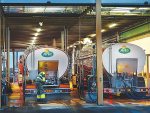
Europe’s largest dairy co-operative to launch in 2026 as Arla Foods and DMK merge
The creation of Europe's largest dairy co-operative should be complete by early 2026.




 increase font size
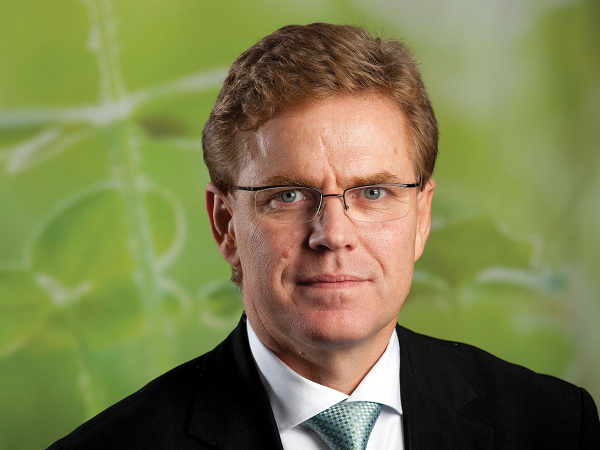 Arla Foods chief executive Peder Tuborgh
European dairy giant Arla Foods celebrated its 25th anniversary as a cross-border, farmer-owned co-operative with a solid half-year result.
For the first six months of 2025, the co-op's group revenues topped $15 billion (EUR7.5 billion) and achieved a net profit of $315m.
Announcing the co-op's half-year results last month, chief executive Peder Tuborgh says the business remained committed to value creation for farmer owners, with a competitive milk price, major investment decisions and continued progress on sustainability.
Arla Foods was formed in 2000 by merging the Swedish cooperative Arla and the Danish cooperative MD Foods.
Arla Foods is today owned by more than 7600 farmers from Denmark, Sweden, the UK, Germany, Belgium, Luxembourg and the Netherlands.
Tuborgh says Arla Foods marked the 25th year milestone by delivering results in line with expectations in a volatile market.
"As we mark our 25th anniversary, Arla Foods' ability to maintain a solid performance in a volatile market clearly demonstrates the strength of our cooperative model and the dedication of our farmer-owners and colleagues," he says.
"Our performance in the first half of 2025 reflects our ongoing commitment to healthy, sustainable dairy and to creating value for all those who depend on Arla Foods."
As expected, geopolitical uncertainty and higher dairy commodity prices created a more challenging market environment in the first half of 2025. These factors led to a 1.5% decline in Arla Foods' branded product sales volumes compared to the first half of last year, as consumers became more cautious in response to higher prices and economic uncertainty.
"Although we saw a slight decline in branded sales volumes in the first half of the year, we expect the situation to improve as we move into the second half," says Tuborgh.
"With continued focus and strength of our brands, we are well positioned to respond to changing market conditions, and we anticipate that branded growth will be close to neutral for the full year."
Growth, Investment
In the first half of 2025, Arla Foods made several major decisions on future investments, reflecting the cooperative's ongoing commitment to future growth, capacity expansion, and innovation across its business.
Key projects included an investment in UHT milk production in the UK, an expansion of cream cheese production capacity in Holstebro, Denmark, an investment in Linköping, Sweden to meet rising demand for Skyr products, and an expansion of cheese-in-glass-jar production capacity in Bahrain.
"Arla Foods' high level of investment decisions in the first half of 2025 is a clear demonstration of our commitment to long-term resilience and reliability," says Tuborgh.
"By strengthening production and supply capabilities, we continue to play an important role in safeguarding food security and ensuring a steady supply of high-quality dairy products for customers and communities across our markets."
Full-year investments are expected to be in the range of $1.4b.
In the coming months, the merger of Arla Foods and DMK Group, another European dairy co-operative, will be concluded.
The creation of Europe's largest dairy co-operative should be complete by early 2026.
OPINION: One of the world’s largest dairy co-operatives has come under fire for embracing a new methane-reducing additive fed to cows. The claims, made on social media, says the use of a feed additive by Arla Foods farmers could ‘contaminate’ milk and allegedly cause cancer.
European dairy co-operative Arla Foods is forecasting a total revenue of nearly $25 billion this year.
Danish dairy co-operative Arla Foods is accelerating sustainability efforts on farm to help customers achieve their reduction targets for scope 3 emissions targets.
OPINION: It's interesting to note that Dutch co-operative Arla Foods is paying its farmers billions for reducing their scope three emissions (that's greenhouse gas emissions generated behind the farmgate).


In Dacre, near Invercargill in New Zealand’s South Island, Bruce Dinnington is running a dairy operation unlike any other.

A free online platform aggregating governance vacancies across rural and regional New Zealand has been launched.
Environment Minister Nicola Grigg has announced details of a new rural plastics recycling scheme.
Agricultural drone operators say that a government decision to allow lower-risk drone work without certification won’t lower standards but drive innovation and efficiency.
OPINION: Warning bells are ringing in the arable sector.
Now in its fourth year, the 2026 Fencing Industry Awards, formed part of the proceedings of the FCANZ Conference, held in Nelson during August.


OPINION: It seems Canterbury processor Synlait is still in the doldrums.
OPINION: Get offside with New Zealand First leader Winston Peters at your own peril.




