
Arla Foods delivers $15b revenue as Co-op turns 25
European dairy giant Arla Foods celebrated its 25th anniversary as a cross-border, farmer-owned co-operative with a solid half-year result.




 increase font size
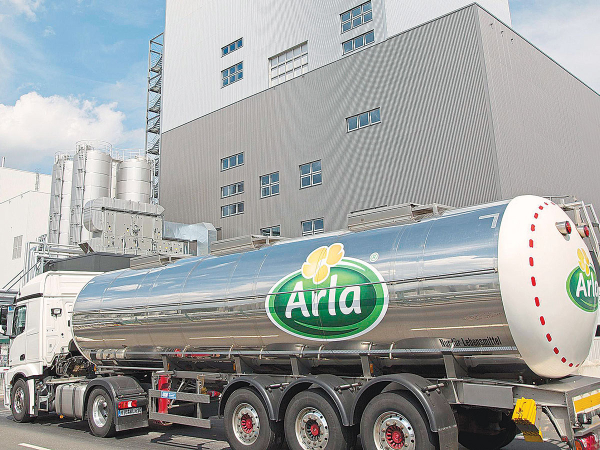 Arla Foods is owned by more than 8400 farmers from Denmark, Sweden, the UK, Germany, Belgium, Luxembourg and the Netherlands.
European dairy co-operative Arla Foods is forecasting a total revenue of nearly $25 billion this year.
The farmer-owned milk processor says that while geopolitical tensions continue, the positive trend on consumer purchasing power from the first half of 2024 should prolong into the second half, especially in Europe as inflationary pressure continues to subside and wages increase.
"This is anticipated to translate into a continued upturn in the demand for dairy, although it is uncertain how consumers will react to the expected higher retail price levels following the commodity price increases," Arla says.
"The uncertainty is also underlined by a lesser volume of available milk on a global level."
Arla Foods is owned by more than 8400 farmers from Denmark, Sweden, the UK, Germany, Belgium, Luxembourg and the Netherlands. The co-op is one of the leading players in the international dairy arena with well-known brands like Arla, Lurpak, Puck and Castello.
For half-year ending June 30, 2024 Arla Foods reported total revenues of almost $12 billio and achieved a net profit of $300m. For the six months, Arla collected 7 billion kg of milk.
Peder Tubough, Arla Foods chief executive says it has delivered a robust half-year performance in 2024 where the positive trajectory from the later part of 2023 has continued.
The performance allowed Arla to increase the milk price by nearly 10c/kg of milk, compared to the second half of 2023 and pay a half-year supplementary payment to farmer owners of 3.5c/kg of milk, based on the half-year volumes.
"We are satisfied that the momentum created by our farmer owners and employers in 2023 has continued into 2024, and today Arla is able to announce a robust half-year result with a competitive milk prices that paves the way for enhanced sustainability efforts going forward," says Tubough.
He notes that the rising milk price and the half-year supplementary payments are mainly driven by rising commodity prices, Arla's Fund Our Future transformations & efficiency programme and a return to branded volume growth.
Arla's strategic brands had a volume driven revenue growth of 4.1% in the first half of 2024 compared to a decrease of 6.0% in the first half of 2023.
The growth was spearheaded by the Lurpak, Puck and Arla brands which respectively grew volumes by 7.9%, 4.4% and 3.8% in the first half of 2024.
"We are very pleased to deliver a competitive milk price.
"At the same time, the return to branded growth happened with a higher magnitude than expected due to the strength of our brands and successful efforts to regain growth, so we are on a positive trajectory."
European dairy giant Arla Foods celebrated its 25th anniversary as a cross-border, farmer-owned co-operative with a solid half-year result.
The creation of Europe's largest dairy co-operative should be complete by early 2026.
Global Dairy Trade (GDT) and Arla Foods have announced that Arla will begin offering European-sourced skim milk powder (SMP) on GDT Pulse from May 2025 as part of an extension to the GDT Pulse pilot.
OPINION: One of the world’s largest dairy co-operatives has come under fire for embracing a new methane-reducing additive fed to cows. The claims, made on social media, says the use of a feed additive by Arla Foods farmers could ‘contaminate’ milk and allegedly cause cancer.
According to numbers sourced from national authorities, 151,800 tractors were registered across Europe in 2023, of which 26,200 tractors (17%) were 37kW (50 hp) and under and 131,900 (83%) were 38kW and above.


The first major update to the Dairy Cattle Code of Welfare in more than a decade has been released, marking what DairyNZ describes as an important step in ensuring animal welfare standards continue to evolve alongside scientific evidence and on-farm realities.

Ravensdown shareholders have elected Jane Montgomery and Kate Acland to the Ravensdown Board for three-year terms, following a closely contested director election.
Federated Farmers says new legislation replacing the Resource Management Act will cut red tape, unlock investment and help grow New Zealand's export-led economy, after the Planning Bill and Natural Environment Bill passed their third reading in Parliament yesterday.
Leading figures from the major political parties will be questioned on their primary sector policies at the Rural Issues Debate at Mystery Creek Events Centre, Hamilton, on 30 September.
OPINION: Have a plan in place now!
Beef + Lamb New Zealand (B+LNZ) says it welcomes the passage of the Natural Environment Bill and Planning Bill, calling the bills a positive step for sheep and beef farmers.


OPINION: It seems Canterbury processor Synlait is still in the doldrums.
OPINION: Get offside with New Zealand First leader Winston Peters at your own peril.




