Kiwifruit Growers Prepare for El Niño, Stay Optimistic
Kiwifruit growers are watchful but remain optimistic as concerns around the potential effects of the El Niño weather pattern this season.
 increase font size
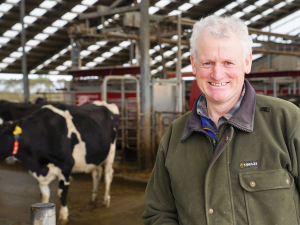
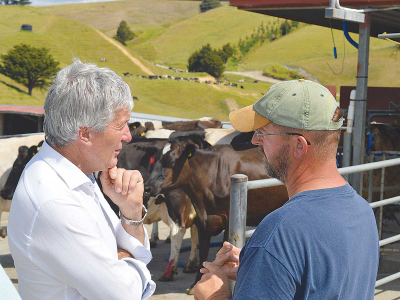 Damien O’Connor with Northland farmer Scott Taylor.
Northland farmer Scott Taylor says rain is urgently needed in parts of Northland to snap the long run of hot and dry days.
Taylor says milk production is falling behind compared to last season as farmers are drying off early. On his farm in Tangiteroria, midway between Whangarei and Dargaville, Taylor has dried off cows that would be calving in autumn: he’s done this a few weeks earlier than usual.
“Day after day of 25 to 30°C with no rain, no grass growth, it’s a no-brainer,” he told Dairy News.
“We need rain soon to ease the pressure, if not things are going to get quite difficult.”
Taylor is still milking 230 cows once-a-day feeding them turnips, grass silage and palm kernel expeller (PKE).
He says Northland farmers have also adjusted to the dry summers by split calving. Taylor switched to split calving three years ago.
“Split calving takes the pressure off spring,” he says.
Northland’s winter is mild and this allows more grass growth than other parts of the country.
Despite parts of Northland receiving its last “decent rainfall” three weeks ago, Taylor believes farmers aren’t hitting the panic button yet.
“Parts of the region are still green and there is some grass growth but every day without rain takes us a day closer to difficulty.”
Two weeks ago, Taylor hosted Minister of Primary Industries Damien O’Connor on his farm, where he milks 380 cows.
He says O’Connor talked to him and some neighbouring farmers about the onset of dry weather.
“It’s good to see the Minister out and about in Northland,” he says. “It gives us a chance to have our say and exchange thoughts with him.”
O’Connor, who spent a day in Northland, says ground conditions across the region are varied.
He praised the resilience of farmers, saying good farmers are more prepared for such climatic events.
“Most farmers have got it... they need to be more prepared in future for disruptive events.”
O’Connor says mixed farming models will help farmers not only diversify their income but provide buffer to their incomes during droughts and floods.
On the possibility of a drought being declared in Northland, O’Connor says his department is working with Federated Farmers and Rural Support Trust with “a set formula”.
“We must not overreact and too quickly declare a drought, building reputation around an area for being unreliable as a farming block,” he says.
“There are downsides to declaration of a drought such areas can be seen as losing the ability to farm sustainably and this can impact land values.”
Kiwifruit growers are watchful but remain optimistic as concerns around the potential effects of the El Niño weather pattern this season.
Farms across the upper North Island are trialling different pasture mixes as part of a research programme that aims to build greater resilience into farming systems.
With forecasters advising El Niño conditions will develop through winter and strengthen into spring and summer, Ballance Agri-Nutrients is encouraging farmers and growers to think ahead about nutrient planning and be prepared to work around challenging weather conditions.
OPINION: Since when did one and one make three? Who didn't smell an elephant-sized rat when our leaders decided to give $60 million to save the cement factory in Northland?
New Zealand needs to make sure that it continues to focus on its own food security, according to HortNZ board member and blueberry grower Dermott Malley.


In Dacre, near Invercargill in New Zealand’s South Island, Bruce Dinnington is running a dairy operation unlike any other.

A free online platform aggregating governance vacancies across rural and regional New Zealand has been launched.
Environment Minister Nicola Grigg has announced details of a new rural plastics recycling scheme.
Agricultural drone operators say that a government decision to allow lower-risk drone work without certification won’t lower standards but drive innovation and efficiency.
OPINION: Warning bells are ringing in the arable sector.
Farmgate lamb prices are down by 8%, beef cattle by 4.5% and farm expenditure up by 4.2%.