Kuhn Group Sales Dip 9% in 2025 but Orders Signal Recovery
Kuhn Group recorded net sales of NZ$2.27 billion in 2025, finishing around 9% lower than in 2024.
 increase font size
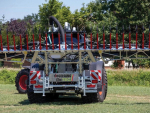
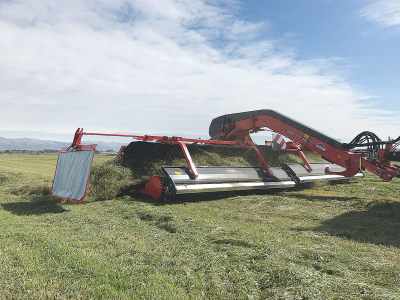 Merge Maxx uses conveyor belts to achieve gentle swathing of forage.
Kuhn NZ will show at Fieldays a new series of bar mower and an addition to its forage raking range — the Merge Maxx 950 belt merger.
In the mower line-up, the all new GMD 355 top drive bar mower, although like the well-known GMD 310 has its cutter bar driven through the top of the first disc, eliminating the need for an inner skid drive which can drag crop when the machine is used for topping.
The FC 3125 and FC 9530 triple mower conditioner remain the maker’s ‘flagship’ machines with premium features such as hydraulic ‘lift control’ suspension and the on-the-fly hydraulic side shift, giving between 30 and 50cm of overlap front to rear.
Complementing the mower ranges, the new GF 8712 T trailed tedder has Kuhn’s new HLC (headland lift control) system that raises all rotors at least 50cm from the ground in five seconds from the tractor’s control unit.
On the swath presentation front, the all-new Merge Maxx 950 belt merger uses a different method of windrowing, two independent pick-ups and hydraulically driven conveying belts to achieve gentle swathing of forage in crops such as lucerne.
Also on the site will be the forage harvester that won the Agritechnica Machine of the Year 2018 award -- the FBP 3135 fixed chamber combi baler. This uses the maker’s patented film on film and net binding systems which help to achieve high silage quality at the lower costs.
The design, said to result in a guaranteed binding start under all circumstances, uses two regular 750mm film rolls rather than one large mantle film roll, saving 30% on film costs due to the higher pre-stretch ratio of 70%.
Operators looking to optimise forage use can see the latest vertical twin-auger mixer wagon -- the Profile 28.2 CL. A new range is available in single auger format from 4m3 to 15m3 or from 12m3 to 34m3 capacity in twin auger configuration.
The Profile 28.2 CL model on display has industry leading K-NOX mixing augers, using an alloy of chrome and ferrites, making it a more ‘stainless’ steel for intensive use.
Kuhn fertiliser spreaders on display will include a fully GPS and ISOBUS controlled simulator. The Axis 40.2 M-EMC represents the high-end of the Kuhn mounted spreader range, with built-in variable rate and section control function ready to unlock. The patented EMC (electronic mass flow control) automatic rate control is said to be unlike any other on the market, weighing its output on each spreading disc every second for unrivalled accuracy.
At the other end of the spectrum, the MDS 19.1 spreader is an entry level twin-disc spreader that’s truly simple. It’s simple to setup via either a flip chart or phone application and simple to operate with a push-button start option or hydraulic open/close via the tractor outlet.
Kuhn Group recorded net sales of NZ$2.27 billion in 2025, finishing around 9% lower than in 2024.
ZED, the dedicated wholesale division of CB Norwood Distributors, and the importer and distributor for Kuhn in New Zealand, has announced investment in local expertise and stock availability for customers in 2026.
Kuhn has announced an expansion of its range of disc mowers, distributed by Norwood in New Zealand, with the addition of two new vertically folding rear mounted models, the GMD 3515 and GMD 4015.
With most forage harvester manufacturers offering machines touching 1000hp, the logistics puzzle has always been ‘dropping” grass and pulling into a swath big enough to feed the “beast”.
French company KUHN has won a EIMA Technical Innovation Award for its Baler Automation Technology.


LIC shareholders have elected a new North Island representative to the co-operative's Board, along with five representatives to its Shareholder Reference Group (SRG), following the company's Annual Meeting held in Invercargill.
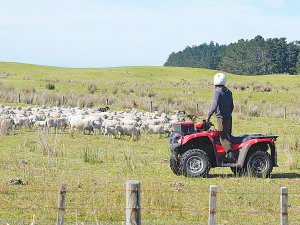
Farmers across parts of Southland and South Otago are continuing to deal with difficult conditions after a prolonged run of wet weather, with pressure building around feed supply, stock management, pasture damage, farm infrastructure and everyday workloads.
Federated Farmers says it welcomes Labour's commitment to reviewing the Sharemilking Agreements Act, calling on other major parties to do the same.
For Canterbury dairy farmers Sian Meijer and Rick Wobben, wearable technology has become one of their most valuable on-farm tools - helping manage 1850 cows across an expansive, high-performing dairy operation while improving efficiency, mating outcomes and day-to-day decision making.
Fonterra has unveiled its annual results for the 2026 financial year, posting $27 billion in revenue and close to $20 billion returned to New Zealand farmer owners and unit holders.
The first major update to the Dairy Cattle Code of Welfare in more than a decade has been released, marking what DairyNZ describes as an important step in ensuring animal welfare standards continue to evolve alongside scientific evidence and on-farm realities.