
Ballance Farm Environment Awards Launch on West Coast
The Ballance Farm Environment Awards are coming to the West Coast of the South Island.
 increase font size
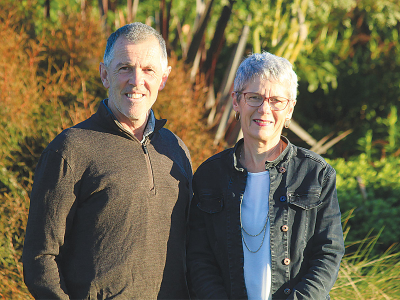 Mark and Jennifer McDonald.
Dairy farmers Mark and Jennifer McDonald began beautifying their 138ha Methven dairy farm a decade ago.
For the first two years, the McDonalds got funding from ECan which helped to get the project on its feet.
They started in 2009, planting New Zealand natives along 300m of road boundary to quell the dust from a shingle road.
The following season, they planted the margins of a 1km spring fed stream crossing their farm on its way to the Ashburton River.
They first planted Kiwi standards toetoe, flax, carex, pittosporum and coprosma. They’ve since added kaikomako, pokaka, kahikatea and pseudopanax. And kowhai, totara and beech have been planted for their wide ground cover and low maintenance.
Mark McDonald says he’s now somewhat addicted to tree planting and has begun to propagate plants.
“It all helps to keep the cost down, and it’s rewarding to collect seeds from the foothills and grow them into trees. And there’s always friends donating seedlings that have popped up in their gardens.
“We also got involved in the Carex Project, a collaboration between ECan and the University of Canterbury, who came to sample water quality each month. The project was to create a set of tools for farmers to use to improve water quality and eco systems in freshwater streams across Canterbury. It was an excellent project to be part of.”
Restoring a wetland
Six years ago the McDonalds decided to develop a small wetland area that had been unsuccessfully tiled some years before. A digger removed drainage pipes and exposed the springs prevalent in the area. A lot of hard work followed.
“We shaped up a pond in one section and contoured the rest. The area was fenced and with help from Ashburton College students on work experience we planted the same basic species,” says McDonald.
They are now seeing a lot of self seeding which provides a source of young plants that can be transferred to other areas.
McDonald says it’s good to see all their hard work starting to pay off.
“We’re starting to see better shading of the stream which has reduced the number of weeds. The stream is home to eels, trout and bird life, and while they’re still mostly introduced species, I’m sure before long we’ll hear bellbirds and tuis on the farm.”
Work goes on
The McDonalds have completed planting along most of the farm’s waterways and are now set on developing two other wetland areas close to the northern branch of the Ashburton River.
“One is covered in willows, and we’re using the existing cover the willows provide to plant kahikatea, matai, totara and beech. Once these trees get established we will poison the willows and cut them out,” says Mark.
“The other area is a low lying one better suited to flaxes, grasses and sedges. We are also in the early stages of restoring a support block near Mayfield which has a significant stream dissecting it.”
The Ballance Farm Environment Awards are coming to the West Coast of the South Island.
There's been widespread support from the primary sector for the Government's announcement on changes to freshwater farm plans that come under the Natural Environment Bill, which is now set to replace the existing RMA.
The chair of the country's environmental regulator, the Environmental Protection Authority (EPA), says changes are already under way to improve the performance of the agency to better meet the needs of those who interface with them.
New Zealand's Emissions Trading Scheme (NZ ETS) encourages afforestation while not achieving climate goals, says a new report released by the Parliamentary Commissioner for the Environment, Simon Upton.
Retiring MP and dairy farmer Mark Cameron is blasting the Green Party for proposing to ban the use of synthetic fertiliser and cutting cow numbers.



Now in its fourth year, the 2026 Fencing Industry Awards, formed part of the proceedings of the FCANZ Conference, held in Nelson during August.
DairyNZ deputy chair Cameron Henderson has been re-appointed unopposed for another term.
OPINION: The stats speak for themselves.
Farms across the upper North Island are trialling different pasture mixes as part of a research programme that aims to build greater resilience into farming systems.
Election years are always a concerning time for farmers, according to DairyNZ chair Tracy Brown.
The Ballance Farm Environment Awards are coming to the West Coast of the South Island.