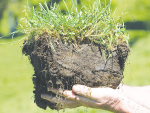
Cost of getting soil fertility wrong
Although many people on the planet are willing to pay more for New Zealand produce, productive land to grow that food and fibre is becoming unavailable here in our own backyard.
 increase font size
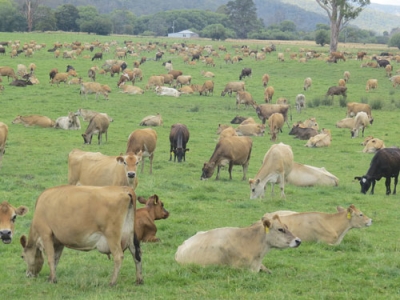 Running an efficient farm is the recipe for Paul Lambert’s success in Tasmania.
Tasmainian dairy farmer Paul Lambert’s secret to success is to make farms efficient.
A former winner of the Tasmanian Dairy Business of the Year award, Lambert loves clearing plantation land to return it to production, especially when it is written off as having little or no potential.
Lambert told the recent Australian Dairy Conference in Tasmania that he sees soil fertility as important in turning farms around. Important during the first few months of development are soil testing and large corrective applications of lime, dolomite, phosphorous and potassium.
He and his wife Nadine run a 700-cow farm at Merseylea, in central north Tasmania. The 180ha irrigated land has four irrigation pivots and he milks cows on a 50-bail rotary platform.
“I have for many years tried to run an efficient farm,” Lambert told Dairy News.
“We probably learnt our skills in profitable dairy farming back in the 1990’s and then expanded from 200 cows to 2400 from 1995 to 2009.
“In 2010 we sold two farms to corporate farmers and now milk 700 on the home farm; we also own a 20% share in a dairy farm where I help with management.”
A Nuffield scholarship in 2011-12 took Lambert away for nearly seven months to study robotic milking and on-farm energy production.
His father Ted has schooled him to run things well and to irrigate as much ground as possible. His father also helps in selecting the right cows.
Lambert says this has resulted in a clean, high-performing herd that produces efficiently under its feeding regime of irrigated grass and 500 tonnes of grain per cow.
Grain costs about A$320 - $350/tonne, he says.
“A lot of dairies are using more and getting good results. This season we will use about half a tonne per cow; the state average would be just over a tonne.”
Pasture growth has also been good, most of the state getting good autumn rains. Things are looking great, he says.
Lambert supplies Murray Goulburn and is looking at a closing price of A$6/kgMS this season.
Tasmania’s dairy industry is booming and the state has been producing close to 1 billion litres of milk every year. Production there could double during the next 10 years, Lambert says.
The government relies heavily on irrigation to better manage water use. The state is said to have 14% of the country’s water on only 3% of the land mass.
Although many people on the planet are willing to pay more for New Zealand produce, productive land to grow that food and fibre is becoming unavailable here in our own backyard.
Hundreds of dairy cows were killed and farms across Tasmania severely damaged this month in the worst flooding many farmers have ever experienced.
Fancy a vodka? Ever thought of looking over the fence for your quaff?
Murray Goulburn has bought Mitsubishi Corporation's remaining 24.1% in Tasmanian Dairy Products Co Pty Ltd (TDP) for A$4.8 million, taking 100% ownership.



Now in its fourth year, the 2026 Fencing Industry Awards, formed part of the proceedings of the FCANZ Conference, held in Nelson during August.
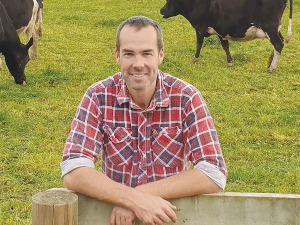
DairyNZ deputy chair Cameron Henderson has been re-appointed unopposed for another term.
OPINION: The stats speak for themselves.
Farms across the upper North Island are trialling different pasture mixes as part of a research programme that aims to build greater resilience into farming systems.
Election years are always a concerning time for farmers, according to DairyNZ chair Tracy Brown.
The Ballance Farm Environment Awards are coming to the West Coast of the South Island.