New Research Shows Good Farming Practices Reducing Nutrient Losses on Dairy Farms
Analysis of decades of research has revealed the good farming pracrtice plays a critical role in reducing nutrient losses to improve freshwater outcomes.
 increase font size
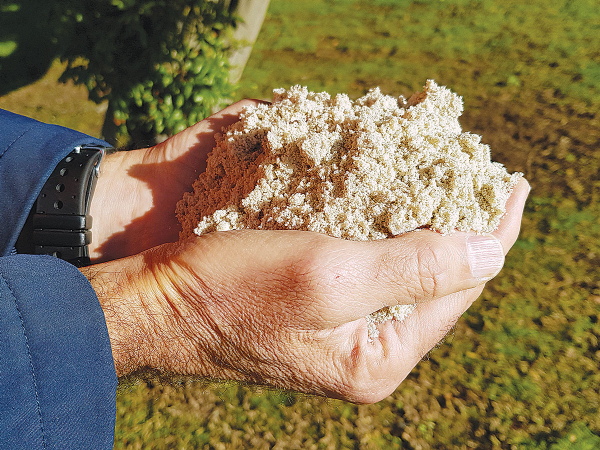 Over the past decade gypsum’s potential for reducing farm runoff has been researched.
Nutrient loss from agricultural systems can reduce waterway quality through eutrophication.
This is where an excess of nutrients occur in bodies of water – due to run-off from the land and causes a dense growth of plant life. The main nutrients involved in eutrophication are nitrogen and phosphorus.
Gypsum has long been used as a soil conditioner and fertiliser in agriculture and horticulture, where it supplies calcium and sulphur as soil friendly nutrients.
However, it is only in the past decade that gypsum’s potential for reducing farm runoff has been researched. Applying the common sulphate mineral to pastures improves water infiltration rates and soil aggregate stability. This reduces surface water runoff and phosphorus losses due to the calcium ions in gypsum binding with phosphorus.
NZ soils are well known for being sulphur deficient; plants require sulphur for protein synthesis. Traditionally, superphosphate has been applied to address this deficiency. However, superphosphate applications increase the concentration of phosphorus in the soil – raising the risk of runoff into nearby waterways.
As an alternative, gypsum is a good source of sulphur. It comes in a form that is readily available to plants and allows the application of sulphur without the need for phosphorus additions.
During the past 20 years in New Zealand there has been a substantial reduction in livestock access and effluent discharges into waterways. But nutrient losses can still occur through surface water runoff and drainage loss of nutrients from the soil.
Drainage losses can include leaching and water flowing down a slope within the soil. These are affected by complex hydrological and chemical factors.
High sodium soils can have a detrimental effect on soil structure and water infiltration. Sodium causes loss of aggregation reduces soil pore spaces and may also increase soil pH in severe situations. By displacing sodium, gypsum restores soil particle aggregation and air spaces in the soil.
Trials in the United States, where applications of gypsum alongside moderate nitrogen applications, found it could diminish the nitrate contamination of surface and ground waters and potentially increase yields*.
Gypsum is best used in targeted areas where there is surface water runoff risk and can be most effective in wide strips around run off prone areas. It also is beneficial in effluent treated areas or pugging prone paddocks rather than over the whole farm. Targeting high risk sections of a farm will assist the economic viability of a gypsum application.
Gypsum is described as a multi tasker for use on farms and it is also BioGro certified. Talk to your advisor for guidance on gypsum applications, based on recent soil lab tests.
• Reference: Use of gypsum to reduce effluent and fertiliser nutrient losses to waterways, T A Jenkins, V Jenkins, Fertiliser and Lime Research Centre, New Zealand. 27th Annual FLRC Workshop held at Massey University, February 2014.
*(Gypsum as an Agricultural amendment, W A Dick, Ohio State University, USA, Bulletin 945).
Analysis of decades of research has revealed the good farming pracrtice plays a critical role in reducing nutrient losses to improve freshwater outcomes.
Gypsum is a highly available calcium source that provides immediately available sulphate sulphur, according to Lindsay Head - an independent horticulture consultant.
Gypsum can at least partially address many hydrological and chemical factors that influence the loss of phosphorus and other nutrients from farms to waterways, says a Canterbury company.
Industry body DairyNZ has come out in support of Ravensdown and Ballance Agri-Nutrients' voluntary suspension of sales and use of Dicyandiamide (DCD) treatment on farm land until further notice.



Pāmu has released its FY26 Integrated Annual Report, reporting a Net Operating Profit of $113 million, more than double the $49 million recorded in FY25.

Meat Industry Association data, released alongside the Red Meat Sector conference in Wellington, shows export value climbing across the US, China, UK and Canada.
Applications are set to open for the 2027 Zanda McDonald Award, a trans-Tasman award recognised for identifying and fast-tracking talented young leaders in agriculture and agribusiness.
The Royal New Zealand College of General Practitioners (the College) and Hauora Taiwhenua Rural Health Network are calling for investment in a proposed new training pathway for rural GPs, warning that many rural practices are struggling to recruit while a large share of the existing workforce nears retirement.
Federated Farmers has called on Central Otago District Council (CODC) to drop or vote down a plan to truck sludge from Alexandra and Cromwell to farmland near Lauder, warning it would compound an "outrageous" situation created by a separate council's decision weeks earlier.
Synlait has swung to second-half profit as operations stabilise, but the dairy processor still posted a $75.4m annual loss.