Ah Tatua, You've Done It Again!
Waikato milk processor Tatua has again declared a record milk payout to farmer shareholders, leaving other processors in the dust.
 increase font size
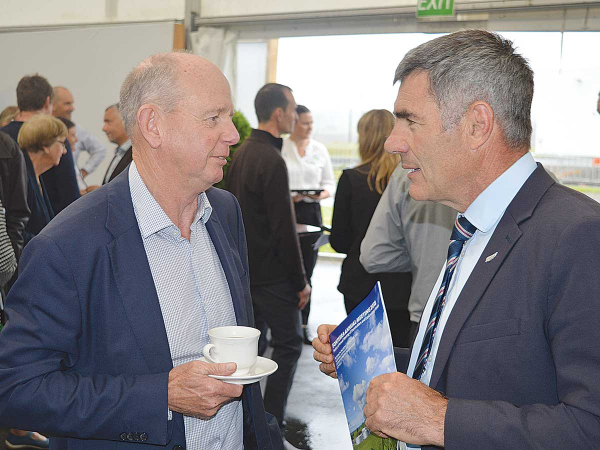 Fonterra Shareholders Fund chairman John Shewan (left) and former agriculture minister Nathan Guy.
Fonterra's unit trading scheme continued to bleed investors in the financial year ending July 2020.
Total institution holdings in Fonterra Shareholders Fund (FSF) declined from 15% to 13% and private wealth dropped from 7% to 5%.
There was also a reduction in offshore investors; New Zealanders now make up 86% of total investors, up 3% from last year. The number of Australian investors dipped 3%.
FSF chairman John Shewan says as Fonterra’s performance continues to improve, it will regain investor confidence. He says the FSF would like to see institutional and private wealth holdings grow.
Shewan says Fonterra’s two years of consecutive losses in 2017-18 and 2018-19 eroded investor confidence. Speaking at the fund’s annual meeting in Auckland last week, he noted that at the start of the 2020 financial year the unit price dipped into the low $3 territory.
This occurred mid-August 2019 as Fonterra advised the market there was going to be a number of write-downs, with an expected loss of $590-$675 million for the previous year.
The unit price recovered in late September 2019 when the co-operative announced the sale of its 50% share in DFE Pharma as part of a strategy review.
Shewan says during the last financial year the unit price broadly followed the NZX50 index, however, it held better than some other listed companies during Covid lockdowns.
The fund finished the financial year, August 1 2019 to July 31 2020, up 8% at $4.06/share, from $3.77 – slightly up relative to the NZX50 index, which had growth of 7% for the same period.
The unit price earlier this month stood at $4.40, an increase of 17% since the start of the 2020 financial year and an increase of 29% on the low point of $3.41 in mid-May.
The fund allows investors to invest in the performance of Fonterra by buying units, giving them economic rights only and no access to Fonterra shares.
For 12 months ending October 30, units on issue jumped 4 million to 106 million units on issue.
During the 12-month period, units issued peaked at 107 million units on issue at mid October 2020.
Shewan noted the increase was predominantly due to farmer share compliance activity.
When a farmer ceases to supply milk to Fonterra, they have three years to reduce their holding in Fonterra shares.
He says in recent times a number of ceased farmers, instead of exiting Fonterra completely, have opted to sell their shares and buy units simultaneously – effectively transferring their Fonterra shares to units.
“There is a significant portion of retired farmers that no longer supply Fonterra milk who are classified as retail holders in the fund, and it is this group who made up a notable portion of the 4% point increase in retail holdings this year.”
Waikato milk processor Tatua has again declared a record milk payout to farmer shareholders, leaving other processors in the dust.
Fonterra has unveiled its annual results for the 2026 financial year, posting $27 billion in revenue and close to $20 billion returned to New Zealand farmer owners and unit holders.
Fonterra Co-operative Group has confirmed the independently assessed candidates standing for election to its board in 2026.
Fonterra has revised its Farmgate Milk Price forecast for the 2026/27 season, lifting the midpoint and narrowing the range on the back of improving global dairy commodity prices.
Outgoing Fonterra Co-operative Council chair John Stevenson says that it has been a privilege to represent the co-op's farmer shareholders.


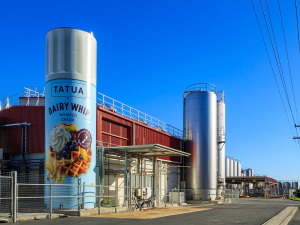
Waikato milk processor Tatua has again declared a record milk payout to farmer shareholders, leaving other processors in the dust.

A Labour-led Government won’t be bringing back the controversial freshwater rules of 2020.
National’s much-touted free trade deal with India featured in the Rural Issues Debate at Mystery Creek, Hamilton on Wednesday night.
New Zealand's 2026-27 freshwater fishing season has opened, with anglers encouraged to head to rivers and lakes over the coming days as conditions look favourable across much of the country.
Central Otago District Council (CODC) has voted against a plan to spread treated sewage sludge from Cromwell and Alexandra on farmland near Lauder, a decision Federated Farmers says reflects strong opposition from rural residents.
Pāmu has released its FY26 Integrated Annual Report, reporting a Net Operating Profit of $113 million, more than double the $49 million recorded in FY25.