Post-quake study reveals hort potential
Large areas of North Canterbury and South Marlborough – affected by the 2016 Kaikoura Earthquakes – offer wide potential for horticulture.
 increase font size
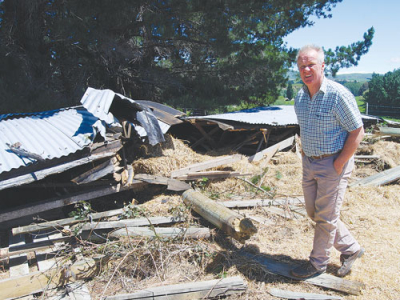 Leader Valley farmer Andrew Harris with a haybarn destroyed by the November 14 quake. Its eight supporting timber poles all snapped cleanly off at ground level.
Getting stock water supplies restored was among the priorities for Leader Valley farmer Andrew Harris in the aftermath of the November 14 earthquakes.
Harris runs sheep, beef, deer and some dairy grazing on his 980ha One Tree Hill farm inland from Parnassus on the Leader River. The valley is the furthest north that non-essential traffic can reach before the roadblocks on SH1 to Kaikoura.
Harris says his homestead is now whitestickered and usable – joking that it suffered “only” three toppled chimneys. But one of those fell onto a bed which was luckily unoccupied. He and wife Liz were in Christchurch when the quake hit, just after midnight on November 14.
Harris says they drove back that morning.
Harris grins and says “we got in when we probably shouldn’t have”. They were let through by a crew working on the cracked and slumped tarseal of the Leader Road.
“We knew them,” says Harris.
On the farm they found the worst damage was to their haybarns, water supplies and grain silos. Luckily their main access, by way of a private single lane bridge over the river, had survived.
At the top of the farm were two concrete water tanks which had hardly moved, but had strangely rotated on their bases.
“They’ve stayed where they were meant to be, but they’ve twisted about 10 degrees and broken all their pipes off. So we had no water for the stock.”
One of the tanks is now back in use with new pipes, but the lid of the other has fallen in and it has been replaced by a new plastic tank. The tanks are fed from the council’s reticulated system which is back in operation, but Harris is still finding damage to the reticulation to the stock troughs.
On the flat, one haybarn has completely collapsed, the main structure of eight wooden poles having broken off so cleanly at ground level that he initially thought, incorrectly, that they may have been rotten.
Nearby, a grain silo which had contained about 20 tonnes of barley has torn itself from the concrete footings it was chained to. Beside it another which contained only about 5 tonnes is still upright but unsafe, with its steel support framework wracked and broken.
Harris says some parts of the farm appear untouched, but a fault line now runs across towards the northern boundary and away into the neighbouring Mendip Hills Station.
Govt support
Primary Industries Minister Nathan Guy has announced cash support for quake-hit primary producers in the upper South Island.
“The earthquakes have had a major impact on farmers, fishers, growers and the wine industry. The damage is widespread and severe and will need the help of the Government to recover,” says Guy.
“This is only a first step and we will be working with local communities to help people recover and get back on their feet.”
At least $5 million will be paid, including:
- $4m for mayoral disaster rural relief funds (Hurunui, Kaikoura and Marlborough) to help with non-insurable assets such as tracks, on-farm bridges and water infrastructure
- $500,000 to support rural recovery coordinators in the Hurunui, Kaikoura and Marlborough districts
- $500,000 extra funding for the Rural Support Trust
- $200,000 per month to mobilise and support skilled primary industry students and workers for farm recovery work
- Rural assistance payments (RAPs) from Work and Income NZ (emergency payments for farmers in real hardship).
“Overall this is a real blow to North Canterbury given this area has suffered drought for nearly three years. However, there is a Government response underway and the community is pulling together to get through,” Guy says.
Large areas of North Canterbury and South Marlborough – affected by the 2016 Kaikoura Earthquakes – offer wide potential for horticulture.
Two years on from the devastating November 2016 Kaikoura earthquake, Kaikoura dairy farmer Graham Collins says he is getting used to “the new normal”.
A New Zealand Winegrowers’ research project, funded by MPI, is hoping to take the lessons from the 7.8 Kaikoura earthquake to build a more resilient industry for the future.
Three months on from the huge November 2016 earthquake the badly damaged land on one farm near Waiau is still settling and moving – but the house isn’t.
Port Nelson has been a key infrastructure asset for the top of the south for decades but its importance to Marlborough is becoming even more significant, following last year’s 7.8 earthquake.



Testing confirms H5 bird flu in a single northern giant petrel, found dead on a remote Cape Palliser beach in the Wairarapa, says Dr Mary van Andel, the Ministry for Primary Industries' (MPI) Chief Veterinary Officer.

"What's for dinner?" may sound like a simple question, but for many Kiwi parents, answering it has become a job in itself.
Fifty Eight years ago, on the 16th of August 1968, August Claas, the founder of the harvesting company and father of Helmut Claas, personally presented a Claas Senator combine harvester to Scottish farmer John Steven.
New Zealand consumers are paying more for beef mince than ever before, with the average retail price now sitting above $24 per kilogram, according to Rabobank.
State farmer Pamu has delivered its strongest operating result on record.
Four years since it was first detected in New Zealand, researchers and growers now know much more about management of maize pest fall armyworm (FAW).