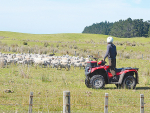
Lanaco and Blueair Launch World-First NZ Wool Air Filter
New Zealand wool is reaching new heights as air filtration companies move away from synthetic products to biodegradable alternatives.
 increase font size

The future of farming described in a recent agricultural scenario is not far distant, says Nick Clark, Federated Farmers manager of general policy and chief economist.
Different scenarios depicting the future farmer are already percolating through, particularly in more intensive dairy operations, he says, as a commentator in the MYOB report.
“As time passes and a new generation comes through, you’ll see more and more of that approach to farming and by 2040 I’d expect it to be much more widespread, perhaps even ubiquitous.”
Clark says compared to where farming has come from – even five years ago – it is amazing how much electronic and machine technology is in use on farms. Farming is perceived by many to be low-skilled and low-tech, but the reality is very different. By 2040 farming will be in many ways a high-tech industry.
“This level of sophistication will be extremely important by 2040 if our productive sector is to meet the opportunities and challenges of the global markets.”
Clark says by 2050, 70% of the world population may be living in cities with more than one million people. “That will have big implications on what people will be eating. It will also have an enormous impact on how countries provide for growing populations in cities. Particularly in Asia they will eat more protein which New Zealand is well placed to provide.”
But New Zealand will face challenges from lower cost producers in the developing world as they become more productive and competitive. New Zealand will also face constraints on land and water and will be subject to more environmental controls.
Since the 1980s, the agricultural sector’s growth has been three times higher than the economy. But we can’t take it for granted that will continue without investment in people, transport, communications, science and genetics, he says.
“One of the areas with a lot of potential is agricultural services – particularly for export. We’ve a got huge expertise developed over many years in agriculture, behind the farm gate and in front of it. There’s a massive market out there for our expertise with the potential to provide an opportunity for a new sector of farming.”
All at a touch!
Excerpts from the agricultural scenario in MYOB’s ‘The Future of Business Report, New Zealand in 2040’, released this month:
New Zealand wool is reaching new heights as air filtration companies move away from synthetic products to biodegradable alternatives.

Generative AI in the workplace, trials in the field, and industry-relevant research took centre stage at this year’s Grape Days events in Central Otago, Hawke’s Bay and Marlborough.
Virtual fencing company Halter is going global but for founder Craig Piggott, New Zealand farmers will always remain their main partners.
Use of agricultural drones by contractors in New Zealand is soaring.
OPINION: New technologies can promise the world but how do we know if they are delivering?


Pāmu has released its FY26 Integrated Annual Report, reporting a Net Operating Profit of $113 million, more than double the $49 million recorded in FY25.

Meat Industry Association data, released alongside the Red Meat Sector conference in Wellington, shows export value climbing across the US, China, UK and Canada.
Applications are set to open for the 2027 Zanda McDonald Award, a trans-Tasman award recognised for identifying and fast-tracking talented young leaders in agriculture and agribusiness.
The Royal New Zealand College of General Practitioners (the College) and Hauora Taiwhenua Rural Health Network are calling for investment in a proposed new training pathway for rural GPs, warning that many rural practices are struggling to recruit while a large share of the existing workforce nears retirement.
Federated Farmers has called on Central Otago District Council (CODC) to drop or vote down a plan to truck sludge from Alexandra and Cromwell to farmland near Lauder, warning it would compound an "outrageous" situation created by a separate council's decision weeks earlier.
Synlait has swung to second-half profit as operations stabilise, but the dairy processor still posted a $75.4m annual loss.