Lanaco and Blueair Launch World-First NZ Wool Air Filter
New Zealand wool is reaching new heights as air filtration companies move away from synthetic products to biodegradable alternatives.
 increase font size
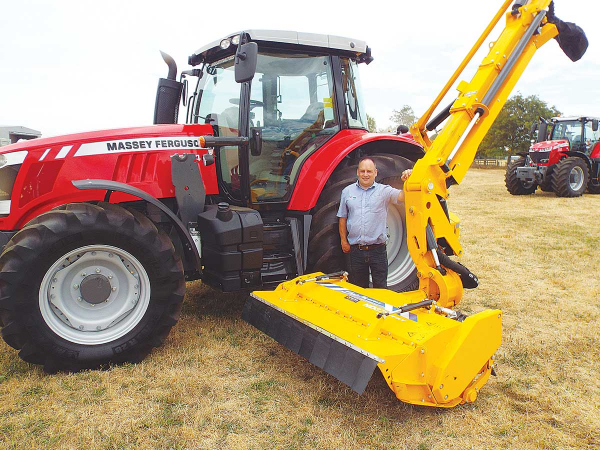 Hamilton-based Ag and Civil Machinery Direct’s product manager David Williams with the Shelbourne HD 876 VFRT hedge cutter.
The Shelbourne HD 876 VFRT hedge cutter chops debris into smaller sizes, removing issues of large debris such as hoof ailments.
Most New Zealand hedges and shelterbelts are kept under control using locally manufactured machines.
However, many of these rely on inertia – meaning that large pieces of debris are often left in roadways or paddocks, leading to problems with punctures or hoof ailments respectively.
This has led to increased interest in European-built machines that use hydraulically driven rotors with flails, such as the Shelbourne Reynolds range brought to NZ by Hamilton-based Ag and Civil Machinery Direct. Importantly, the design of these machines sees any debris “chopped” to a small particle size that after cutting is deposited back in the hedge bottom.
The company reports that despite a range of 12 models, most interest is around the high-capacity machines in the HD 800 series. It says the HD 875 VFRT is proving to be the most popular.
Featuring a five-point mounting system that combines axle brackets and subframes. The machine offers parallel arm geometry and a telescopic boom to achieve reach of 6.2 to 7.5 metres and 1.6m rearward and 2.5 metres forward reach. This means that during operation visibility is particularly good as the cutting head will typically be alongside the side entry to the tractor.
The layout of the machine sees an integral 230 litre hydraulic reservoir and integral cooling system. This allows oil flow from the 85hp hydraulic pump to be delivered to a 1.5 metre cutting head that also incorporates an 85hp motor. The cutting head carries multiple swinging, cast steel “T” flails that leave a smooth finish, while also offering roller options for use with units dealing with roadside verges.
Looking at the construction in more detail, high grade steel is used extensively in the boom design, while also incorporating 60mm diameter pivot pins fitted with phosphor-bronze bushes. For the NZ market, the favoured control system uses an electric over hydraulic configuration, which allows proportional control. This also enables the variable reach and telescopic functions to be used simultaneously. For transport, the boom can be slewed to 103 degrees from the lateral position, bringing it well behind the tractor to reduce overall transport width.
Standard equipment includes a reversible fan on the oil cooler system, head and arm float functions and auto break back reset. Options include hydraulically adjusted head rollers, twin accumulators, debris blowers to “sweep” roads and a hi-vis kit that includes stickers and strobe lights.
Product manager David Williams suggests the HD 875 VFRT is best suited for attachment to six-cylinder tractors of 140+hp.
New Zealand wool is reaching new heights as air filtration companies move away from synthetic products to biodegradable alternatives.

Generative AI in the workplace, trials in the field, and industry-relevant research took centre stage at this year’s Grape Days events in Central Otago, Hawke’s Bay and Marlborough.
Virtual fencing company Halter is going global but for founder Craig Piggott, New Zealand farmers will always remain their main partners.
Use of agricultural drones by contractors in New Zealand is soaring.
OPINION: New technologies can promise the world but how do we know if they are delivering?


Pāmu has released its FY26 Integrated Annual Report, reporting a Net Operating Profit of $113 million, more than double the $49 million recorded in FY25.

Meat Industry Association data, released alongside the Red Meat Sector conference in Wellington, shows export value climbing across the US, China, UK and Canada.
Applications are set to open for the 2027 Zanda McDonald Award, a trans-Tasman award recognised for identifying and fast-tracking talented young leaders in agriculture and agribusiness.
The Royal New Zealand College of General Practitioners (the College) and Hauora Taiwhenua Rural Health Network are calling for investment in a proposed new training pathway for rural GPs, warning that many rural practices are struggling to recruit while a large share of the existing workforce nears retirement.
Federated Farmers has called on Central Otago District Council (CODC) to drop or vote down a plan to truck sludge from Alexandra and Cromwell to farmland near Lauder, warning it would compound an "outrageous" situation created by a separate council's decision weeks earlier.
Synlait has swung to second-half profit as operations stabilise, but the dairy processor still posted a $75.4m annual loss.