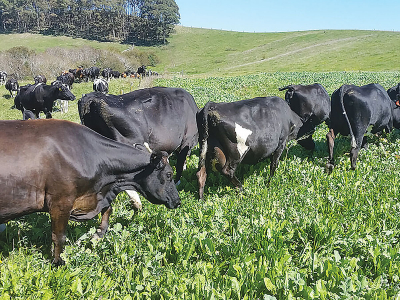
Successful grazing of crop paddocks is achieved by good management of people, cows and the environment, says DairyNZ.
Soil loss risk increases markedly with the grazing of crop. This is due to the combined effect of having no vegetation to filter overland flow, and grazing related soil damage reducing the soil’s ability to absorb water.
Grazing near waterways and carefully managing critical source areas (CSAs) can reduce losses of sediment and phosphorus from the paddock by 80-90%.
Buffer zones or grass strips in and around CSAs and next to waterways act as filters by slowing overland flow to trap suspended contaminants.
Where possible, graze the paddock towards the CSA, leaving an ungrazed buffer to filter runoff. If this is not possible, leave a buffer around the CSA and graze this buffer last in fine weather.
The faster the water is flowing into a buffer zone (ie. the greater the slope of the paddock) the wider the buffer zone will need to be to provide time for effective filtering and infiltration.
P21 Project trial work at Telford Research Farm showed protection of CSAs and correct management reduced soil and phosphorus losses by 80-90%.
If the soil is undamaged in a buffer zone this will allow the water to soak in (infiltrate) and therefore decrease the amount of water available for overland flow.
Reduce soil damage by using a back fence to reduce the herd’s walking and so reduce the soil damage caused by treading. Treading damage seals the soil surface, resulting in more water moving across the soil (runoff), which increases the loss of soil and nutrients.
Cows must have access to fresh water every day. The use and regular shifting of portable water troughs together with back fencing will reduce soil treading damage. If it is not possible to use a portable trough, set up a back fence at the permanent trough.
Cows must be transitioned onto winter crops to allow their gut bacteria to adjust to a new feed source. Transitioning onto brassicas (kale, swede, turnips and rape) will not take as long as onto fodder beet. Poorly managed transition can result in sick or dead cows.
Cows must be allocated enough feed to achieve their body condition score targets. Feed utilisation rates on crop based diets are often lower than grazed pasture diets and must be taken into account when determining appropriate allocations.
Feed utilisation rate can be influenced by grazing management. Reduce trampling wastage by moving the fence once or twice a day rather than offering a few days feed at a time.
Crop is utilised more efficiently when long, narrow breaks -- rather than wide breaks -- are offered, as less of the crop is trampled. Ensure all cows have access to the crop by providing 0.7m of feed face per cow. If the paddock has a short feeding face, consider splitting the herd by condition score, and feeding both ends at the same time, rather than running the animals in one larger herd.
Downhill grazing interrupts a cow’s natural grazing stance, which decreases crop utilisation. More crop or supplement may need to be allocated to ensure they do not lose condition.
Cold stress
If a cow is clean and dry and there is little wind or rain, cold stress is rare until ambient temperature falls below --10°C (minus 10degC). The factors that increase the risk of cold stress are:
• low temperatures
• wind, rain, and mud
• low condition scores
• low feeding levels.