
Beef + Lamb New Zealand Awards 2026 Winners Announced in Christchurch
Last night saw the winners of the 2026 Beef + Lamb New Zealand (B+LNZ) Awards named at a gala dinner at Te Pae Christchurch Convention Centre.
 increase font size
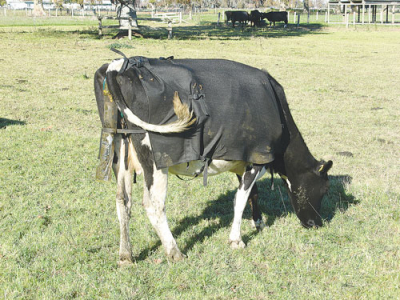 Cow wearing a urine sensor.
AgResearch says it has developed world-leading sensors to better understand how nitrogen is being excreted by cows, and so how best to tackle its effects on the environment.
The urine sensors, a work in progress since 2010, are attached to grazing dairy cows to get detailed measurements every time the cow urinates, including volume and frequency, and crucially the concentration of nitrogen in the urine that may leach into soil and waterways, perhaps causing algal bloom.
The urine sensors give much greater understanding of the behaviour of the cows, which can help develop techniques to mitigate nitrogen leaching from farms, says AgResearch senior scientist Dr Brendon Welten.
“Other sensors exist around the world to provide data from livestock, but these sensors we’ve developed are unique in their ability to record nitrogen concentrations each time the cow urinates during grazing,” Welten says.
“We can learn, for example, how different species of pasture affect the amount of nitrogen excreted in urine.”
The sensors weigh about 1.5kg and attach to the cow by a harness connected to a lightweight cow cover. Several instruments record the data (temperature, pressure and refractive index), storing it in a data logger remotely accessed via a wireless network system.
The sensors have already been used in the UK and Australia.
“The operation of the sensors is complex, and at this stage we are working towards offering the sensors to other researchers around the world to allow them to use the technology to make similar gains,” Welten says.
“AgResearch will have the expertise to support those researchers to use the technology and maximise the benefits from it.”
The sensors have contributed to important progress made in the Forages for Reduced Nitrate Leaching (FRNL) programme involving DairyNZ, AgResearch, Plant & Food Research, Lincoln University, the Foundation for Arable Research and Manaaki Whenua (Landcare Research).
DairyNZ senior scientist Ina Pinxterhuis says the results confirm the variability in urinary nitrogen excretion over the day, necessitating many repeated measures. “The sensors make this possible.”
“It is also great to see that the options we examine to reduce nitrate leaching result in lower daily urinary nitrogen excretion and lower nitrogen concentration, if not during the whole 24 hours of the day, at least for some parts. This information provides new options for management too.”
Last night saw the winners of the 2026 Beef + Lamb New Zealand (B+LNZ) Awards named at a gala dinner at Te Pae Christchurch Convention Centre.
A significant breakthrough in understanding facial eczema (FE) in livestock brings New Zealand closer to reducing the disease’s devastating impact on farmers, animals, and rural communities.
A breakthrough in the understanding of Facial Eczema (FE) in livestock could bring New Zealand closer to reducing the disease’s impact.
An innovative idea for transforming mechanically deboned meat (MDM) into a meat flake for seasoning has taken top honours in the Meat Industry Association’s (MIA) first-ever Dragon’s Den competition.
The Government's plan to merge the seven crown institutes presents exciting possibilities for plant technology company Grasslanz Technology, says chief executive Megan Skiffington.


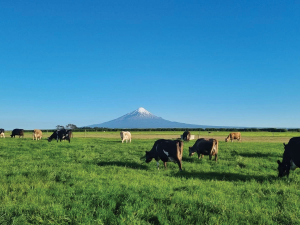
A spate of southerly winds bringing cold temperatures has presented challenges for Taranaki dairy farmers.
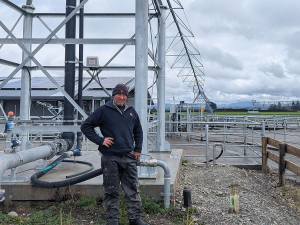
Converting a longstanding cropping farm to dairy was the only way to ensure the land stayed in the family long term, says new dairy farmer Rod May.
As the election heats up, Organics Aotearoa New Zealand (OANZ) has launched its election scorecard designed to help voters wanting to support policies that grow organic and New Zealand's organic sector.
A 'tsunami' of milk from key exporting countries is winding down and this may be good news for New Zealand dairy farmers.
Will the good times last? That's one of the key issues to come out of the latest Federated Farmers confidence survey.
Outgoing Fonterra Co-operative Council chair John Stevenson says that it has been a privilege to represent the co-op's farmer shareholders.