Fonterra FY26 Results: $9.69 Milk Price, $3.4bn Profit
Fonterra has unveiled its annual results for the 2026 financial year, posting $27 billion in revenue and close to $20 billion returned to New Zealand farmer owners and unit holders.
 increase font size
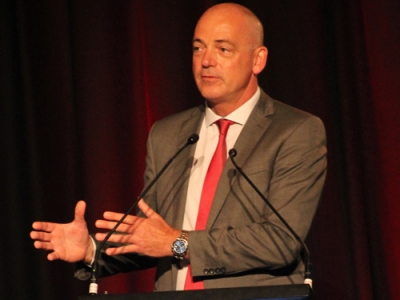 Theo Spierings at the China Business Summit in Auckland.
Fonterra is setting up hubs of entrepreneurial young people to develop new business models, says Fonterra chief executive Theo Spierings.
He says even he is too old for the kind of thinking needed: it requires 20-25-year-olds. Three hubs have already been set up in Asia, and he plans another in Auckland via their graduate programme.
"You see the entrepreneurial mindsets kicking in big time," Spierings told Rural News. "You need to disrupt your own system... If you want to develop a good commerce strategy you need to think differently.
"I'm too old; you need young people like my kids, they don't watch TV, they watch YouTube. They are constantly connected in social media. So it is a completely different world. We have no clue what it means.
"We need these people with brains to develop the business models for the future. If we don't get these people in, these youngsters with brains from a high level, we cannot follow China because the transformation is going so fast."
Spierings says China does not have a vested interest – as does US or Europe – in massive infrastructure or distributors and retailers. So China can shift from the traditional sales channels to the new sales channels much faster than anybody else.
"They can shift the game from here to there and it is scary because it is a 1.4 billion people shift."
Fonterra's hubs of young people have already been set up in Malaysia, China and Indonesia, reporting to the managing director, Spierings says. He wants another in digital and e-commerce in Auckland via the graduate programme.
"We push them to come up with the best possible business models and the best get rewarded. We tell them you get NZ$5m to invest in the business model and come back in a year and show that it works. These are peanut investments but you can get huge results."
Earlier he told a China Business Summit in Auckland these groups of 20-25-year-olds are like Dragon's Den – a television programme where people with a business idea pitch to potential investors.
He said in his previous company in 2008 they used the same approach for a baby food brand. The successful model got 10m euros to invest; now it is a 1b euro business with a 200m euro profit.
China's demographics are changing: they have a 1-2 child policy and 400-500m middle class people with good income but technology and e-commerce may be the biggest disruption.
"If we're not as fast as China and China's consumers we will lose market share."
Fonterra has unveiled its annual results for the 2026 financial year, posting $27 billion in revenue and close to $20 billion returned to New Zealand farmer owners and unit holders.
Fonterra Co-operative Group has confirmed the independently assessed candidates standing for election to its board in 2026.
Fonterra has revised its Farmgate Milk Price forecast for the 2026/27 season, lifting the midpoint and narrowing the range on the back of improving global dairy commodity prices.
Outgoing Fonterra Co-operative Council chair John Stevenson says that it has been a privilege to represent the co-op's farmer shareholders.
OPINION: It seems Canterbury processor Synlait is still in the doldrums.


Federated Farmers says it welcomes Labour's commitment to reviewing the Sharemilking Agreements Act, calling on other major parties to do the same.
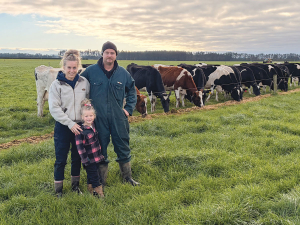
For Canterbury dairy farmers Sian Meijer and Rick Wobben, wearable technology has become one of their most valuable on-farm tools - helping manage 1850 cows across an expansive, high-performing dairy operation while improving efficiency, mating outcomes and day-to-day decision making.
Fonterra has unveiled its annual results for the 2026 financial year, posting $27 billion in revenue and close to $20 billion returned to New Zealand farmer owners and unit holders.
The first major update to the Dairy Cattle Code of Welfare in more than a decade has been released, marking what DairyNZ describes as an important step in ensuring animal welfare standards continue to evolve alongside scientific evidence and on-farm realities.
Ravensdown shareholders have elected Jane Montgomery and Kate Acland to the Ravensdown Board for three-year terms, following a closely contested director election.
Federated Farmers says new legislation replacing the Resource Management Act will cut red tape, unlock investment and help grow New Zealand's export-led economy, after the Planning Bill and Natural Environment Bill passed their third reading in Parliament yesterday.