Two milk processing plants changing hands
Two large milk processing plants in New Zealand are changing hands.
 increase font size
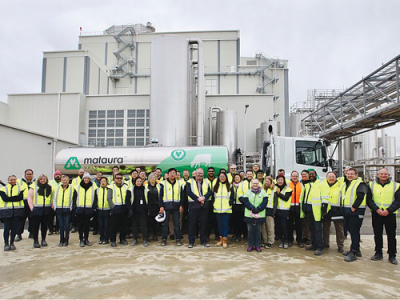 Staff at the official opening of the Mataura Valley Milk plant.
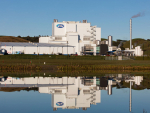
After eight years hard work, Mataura Valley Milk’s new $240 million nutrition plant at McNab, near Gore, has begun production on schedule.
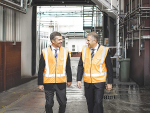
The plant opened with general manager Bernard May and founding director Ian Tulloch partnering in a ribbon-cutting ceremony. The plant accepted its first milk from its farmer suppliers on August 20.
Tulloch said it was satisfying to see the plant open after eight years of hard work by a lot of people.
“It’s having a big impact on the district. It’s exciting times.”
MVM’s major shareholder, the China Animal Husbandry Group (CAHG), have been good partners in the project, Tulloch said.
A group of local businessmen and farmers including Tulloch, a former district mayor (also known as ‘Inky’ to generations of motor-racing fans), had worked for several years to set up a locally based milk processor; then the project took flight with major CAHG investment in 2016.
The plant was designed as the first in Australasia to be certified to USFDA standards. It is expected to process about 500,000L of whole milk a day, producing about 30,000 tonnes of infant formula a year at full capacity, with 80-85% exported. It will have about 65 full-time employees.
China Animal Husbandry Group is among the largest of China’s SOEs in the agriculture sector. Hamilton-based BODCO, itself partly owned by CAHG, also has a small shareholding in Mataura Valley Milk, and will handle the canning of some of MVM’s product.
Bernard May thanked the people who have contributed to the company’s vision taking another step towards reality.
“It’s a proud day for our team and everyone involved in developing what we believe will be the world’s best nutrition business,” he said.
“We’re very happy with the spread of suppliers and their proximity to the nutrition plant.”
Phill, Alet and Jimmy Gerritsen, who farm in the nearby Waikaka Valley, said being shareholder suppliers to MVM felt like being part of a family.
“We work hard to produce the best possible product and to be fairly rewarded for that is important,” Jimmy said.
“Obviously for Gore as well there’s a lot of people coming in and a lot of money being spent here,” Alet said.
Rosie and Malcolm McIntosh, who also farm in the Waikaka Valley, said they were delighted to be supplying their milk to a high-value processing plant.
“We did a fair bit of homework and looked at the plant, and that it was going to be at the high end of the nutritional formula market. They wanted good milk and we have good milk, so it made sense,” Malcolm said.
They saw MVM employing the best people and implementing the best technology and processes and knew their milk would be in good hands.
Demand for quality nutrition worldwide is growing fast and NZ is in an excellent position to produce and export high quality nutritional products, he said.
May said MVM has been dealing with significant international nutritional customers from the start and will be producing product from day one.
“We’re delivering what we said we would and customers are on board.”
Two large milk processing plants in New Zealand are changing hands.
OPINION: Nearly four years after buying a 75% stake in Southland processor Mataura Valley Milk (MVM), A2 Milk is still struggling to take the plant to profitability.
Southland-based Mataura Valley Milk can now lay claim to be the first all-electric dairy factory in New Zealand.
The a2 Milk Company (a2C) efforts to return its Southland-based subsidiary Mataura Valley Milk to profitability remains a work in progress.
The A2 Milk Company (a2MC) says returning its Southland-based Mataura Valley Milk (MVM) plant to profitability remains a key strategic focus.

High country stations, mixed sheep and beef farms, Māori-owned farms, corporates and family operations are among the nine commercial farms taking part in the Livestock Innovation Farming Transformation programme, known as LIFT.
OPINION: New health and safety guidance unveiled by the Government recently provides farmers greater certainty about what is expected of them when managing risks on farm.
The National Animal Welfare Advisory Committee (NAWAC) is seeking public feedback on proposed changes to the Code of Welfare for Rodeos.
A New Zealand initiative supporting farmers to restore the health of grazing landscapes has received international backing through the Regenerative Fund for Nature, a global collaborative fund supporting regenerative agriculture and the communities that produce natural fibres for the fashion industry.
Combine premium New Zealand products, blend in a family ritual and what do you get? A world-class functional drink.
Entries are now open across eleven regions for the 2027 New Zealand Dairy Industry Awards (NZDIA).