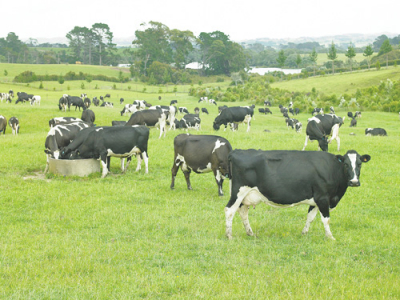
Many farms are struggling with wet soils making for slower growth rates and poorer utilisation.
The result is lower average pasture cover (APC) than planned for. And cows have been stood off a lot so some are not in ideal condition.
What can be done to manage your way through? Hold tight to your rotation plan.
It is vital that you are not tempted to use more area in a week than your spring rotation planner (SRP) allows. In wet weather stand the late calvers off on the yard or select sacrifice paddocks that can be cropped in spring. Springers can be moved to a new break on very wet afternoons/nights to keep them full and content, and next day you should cut back their next break if possible.
The old saying ‘grass grows grass’ is true. If you let your APC drop below 1800 then you will have less leaf intercepting light; going below 1800 will mean slower growth rates than at 2000 APC.
Ultimately you want to end up at your target APC soon after balance date. For a farm stocked at 3 cows/ha and on a 21 day round length this will be about 2100 APC, so that is your target APC to aim for.
The goal in August and September is to steadily feed your cows better each week to provide a rising plane of nutrition. Don’t build up your cows too soon if you know you are likely to run short of grass or supplements, and then have to cut cows intakes suddenly.
Feeding supplements
Different farms have different abilities to store and feed supplements. Feeding these can allow you to hold onto the correct areas each day and week and ensure that milkers are grazing no lower than 1500.
Supplements need to be bought based on the cost of being fed out at 5% of payout -- about 30-32c/kgDM.
Once a day milking (OAD)
OAD milking can be a good way to reduce pasture demand, but this is not immediate. Cows take 4-6 weeks of being milked on OAD in spring to reduce their intake levels. So you may not reduce your pasture demand, but you slow the rate at which cows lose weight.
Expect some relatively small milk losses on OAD, especially going past the first three weeks on OAD. One tactic can be to milk the first three weeks of calving cows on OAD, and then put these onto TAD, while starting the next three weeks of calving cows on OAD for their first three weeks, then onto TAD. After that time, reassess and decide if the first calvers and lightest R3s should stay on OAD.
Milking all your colostrums on OAD provides extra valuable time and reduces metabolic issues. Just milk your newly calved cows as soon as possible after calving, then again the next morning with all current colostrums. This will reduce mastitis cases.
Pro-Gibb
This can be used successfully in August and September to bring later pasture growth forward to when the real deficit exists. The cost works out at about 20c/extra DM grown (assuming a contractor applies the product). Best to apply it behind the cows 3-5 days post-grazing. Do one full round and then stop. Don’t use ProGibb instead of nitrogen; these two products used together are cumulative.
Nitrogen
Soil temperatures in August and September will be well above 8oC, so nitrogen should be used behind the cows. If you are very short and it has been two months since the farm had any nitrogen, you can do three-quarters of the farm in one hit and then follow the cows.
Take time to assess where you are pasture-wise and work out a plan to overcome the deficit that suits your own farm.
• Darren Sutton is LIC FarmWise consultant.