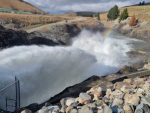
The drought in South Canterbury has prompted one non-irrigating farmer in the Opuha Water area to question the irrigation firm’s first-come, first-served water allocation.
“The way the water’s allocated has exacerbated the feed shortage,” says Jeremy Talbot, who farms nearby at Waitohi. “The dairy farms have used it all, in some cases far from efficiently and now there’s none left for the cropping farmers to grow the winter feed that’s so badly needed.”
Cropping farmers miss out because their demand is low mid-summer when combinable crops are ripening but most years they need water after harvest to establish green feeds such as oats or brassica for winter.
“That’s especially important in a year like this when, given the looming feed shortage, they could plant an increased area to meet the demand. But they’re unlikely to take the risk because the water’s not available,” says Talbot.
With the prospect of water running out, irrigation has been running 24/7, even in hot nor’west weather when it should have been turned off to conserve supplies and reduce losses, argues Talbot.
“But nobody’s been doing that, even though they’ve been on 50% restriction for nearly two months. Admittedly, on-off irrigation is hard to manage with the scheme’s current layout but that could be fixed with either on-farm or communal storage. There are plenty of sites in the catchment that would need little more than a liner to make a useful pond.”
Opuha Water chief executive Tony McCormick acknowledges the different water use patterns depending on land use. “I am aware of the calls by some shareholders to review how we allocate water through the season and this will undoubtedly be part of our review of the season and our operation in a dry season.”
However, the dam has met demand every other season since it was commissioned in 1999. “[We expect to] be able to supply the reasonable needs of all our shareholders.”
With regard to Talbot’s pond suggestion, McCormick says Opuha’s water supply agreements require any stores of water taken from the scheme to have board approval. “Essentially this is because any storage pond operated by an individual irrigator impacts on the reliability of all our shareholders. We are a collective, co-operative company so it is essential we manage the interests of all our shareholders.”
A policy on private storage ponds is being developed. “The concept of ponds that can store water from one part of the season for [use in] another is quite different from anything that has either been built or considered to date. [Storage] is the function of the lake.”
The few existing onfarm ponds are typically to buffer storage and allow application rates that may be different from what the scheme delivers, he explains.
Onfarm ponds filled in winter could, in principle, improve reliability but many irrigation consents have seasonal limits on them, which could create a problem with winter filling, he adds.
The scheme already has a few ponds downstream of the dam but they are to improve distribution efficiency rather than add storage. For example, adding an 80,000m3 buffer pond has allowed one branch of the scheme to be doubled from 300ha to 600ha.
“A pond to ‘store’ just one month’s water sufficient for 300ha would need to be four times larger. The bottom line is there is considerably better ‘bang-for-buck’ in building integrated operational buffer ponds than in building storage ponds on farm. We already have the storage facility in the lake.”