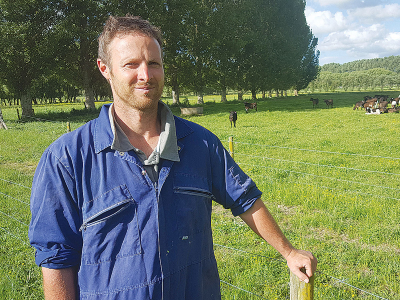
For Waikato sharemilker Philip Van Heuven, the farmer-grazier relationship is crucial to his business.
And he keeps a rigorous watch on stock movements via the NAIT system, reports the agency tasked with this.
He says farmers rely on good and healthy stock to come back from grazing farms.
Van Heuven is preparing to move livestock off-farm for winter grazing. He farms, with his partner Erin, a herd of 340 Friesian-Jerseys on 100ha at Ngahinapouri south of Hamilton.
He has been with one grazier for three years.
“That’s where our r2’s (heifers) go, and two years with the other grazier (weaner calves until they are moved as yearlings). We keep in good contact with our graziers and regularly check when we can.
“It’s very important and crucial to our farming business as we rely on good healthy stock to come back.”
Van Heuven, two years into a three year 50:50 sharemilking contract, has one NAIT location to manage. He says preparations for grazing are going well.
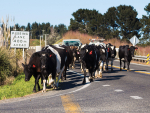
“The yearlings are due to be moved to next grazing this month, while the two-year olds will be coming home.
“I generally contact the stock truck and they notify the graziers who confirm the movements in the NAIT online system.
“The graziers we use are at Putaruru and Fitzgerald Glade about an hour away from the farm.”
Since the farm is not in a movement control area it isn’t required to do TB testing before sending animals away.
“But we will get notified when it is our turn by AsureQuality, who manage the TB testing.”
Van Heuven exchanges Animal Status Declaration forms with his graziers.
“We have a policy of ensuring the dockets are fully completed and go with the stock truck.
“That way, there is a record of the NAIT number from my farm and the number at the graziers.
Essential to business
Philip van Heuven manages NAIT on farm with visual tags, although he has a scanner.
Most of his livestock has at least two or three tags on them, so that works best for his farm.
“Our Minda set-up is in synch with the NAIT online system so we avoid duplication when it comes to registering animals.
“All our heifer calves get tagged with birth identification tags as soon as they are born. This information is transferred through to the graziers’ NAIT account.
“I believe strongly in the value of lifetime traceability, it’s so important that sharemilkers do this, especially for future proofing as diseases can be easily spread.”
Van Heuven says NAIT is essential to his business.
“It protects your business and livelihood. We need an animal traceability system that is robust and reliable. The ability to trace animals and the farms they’ve been at has been especially important since the Mycoplasma bovis outbreak.”
For farmers who haven’t updated their NAIT account, he has a simple message.
“You don’t have a choice, it is compulsory and the law. It could also prove to be a costly decision if your herd ends up being identified with M. bovis and perhaps some other nasty livestock disease.”