
Tongan Student Wins Final William Gearish Award
Vetekina Pau'u is the first Tongan to win the William Gearish Memorial prize and sadly she will also be the last recipient.



 increase font size
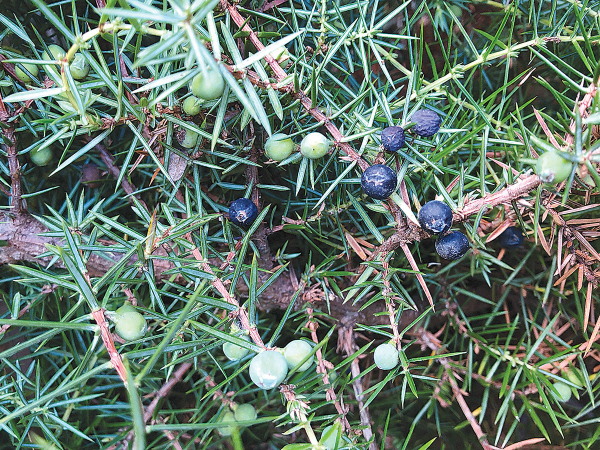 The image shows Juniperus communis berries at varying stages of ripeness. The berries are green initially, then darken over time and are ripe after three years.
Despite a plethora of new gins appearing all over NZ, the country is yet to grow local juniper berries at any scale for gin production or for export.
So, in collaboration with Juno Gin - and funded by the Massey University-Bashford Nicholls Trust Pivot Award - Massey researchers are working on a range of projects aimed at advancing a juniper berry industry for New Zealand.
"We have significantly more 'ground to cover' to grow our understandings of New Zealand-grown Juniperis communis' potential for the local food and beverage industry," explains project coordinator Eve Kawana-Brown. "Like how best to breed, grow and crop for such an industry. However, we are now making good progress."
The research builds on The Great NZ Juniper Hunt, and work that was completed via a Juniper Genetics Study, which Massey University and Begin Distilling (Juno Gin) collaborated together on from 2017-2020.
This latest project brings together the combined experience and expertise of Massey researchers from a range of disciplines to work together in complementary ways to progress the research needed to support the evolution of a juniper berry industry for New Zealand.
A significant focus of the research will be to further examine New Zealand-grown juniper berries to determine if different terroir might lead to distinctive sensory profiles in New Zealand-made gins.
Early research completed by Massey genetics researchers has established that New Zealand's stockholding appears to be fairly genetically diverse, which is important when embarking on growing healthy and resilient populations of any plant variety. Ongoing work to develop genetic markers will help with studying diversity in the New Zealand stockholdings relative to global collections.
Because producing plants from seeds or from imported living plant materials poses significant challenges, the researchers' plan is to progress to trialling in-field plantings from these New Zealand-derived plants.
Early indications are that the New Zealand berries may exhibit unique volatile oil attributes. Juno Gin's Dave James believes that 'terroir effects' in New Zealand for J. communis could enhance the value of the berries, and therefore New Zealand-made product in international markets.
However, it seems there are only a mere handful of fruiting trees in New Zealand. The researchers have only received sufficient quantities from two sources for preliminary berry volatiles analysis to date.
The team are working with four owners of berry-bearing trees to obtain samples for further analysis this year.
They want to understand whether the volatiles profiles from New Zealand-grown berries are actually favourable for gin-making.
A Team Effort!
Professor Joanne Hort, Fonterra-Riddet chair of consumer and sensory in the testing lab at Massey's School of Food and Advanced Technology, is leading work to analyse the attributes of gins made from NZ-grown juniper berries.
Meanwhile, Dr David Popovich from the School of Food and Advanced Technology is studying their volatiles profile, as well a drying and storage protocols. Dr Svetla Sofkova and postgraduate student/technician Su Liu - from the School of Agriculture and Environment - are learning more about the propagation and reproductive biology of juniper plants.
Meanwhile, Dr Vaughan Symonds from the School of Natural Sciences is focused on analysing genetic diversity within Juniperus communis.
The researchers have been continuing to experiment with propagation techniques and currently have 482 Juniperus communi seedlings at varying stages of juvenile development.
Vetekina Pau'u is the first Tongan to win the William Gearish Memorial prize and sadly she will also be the last recipient.
Researchers at Massey University are using a special piece of scientific equipment to improve the measurement of greenhouse gas emissions from pasture soils.
Interest in agritech and production animal systems has prompted Massey University's School of Agriculture and the Environment to new majors to its popular animal science degree.
The industry is crying out for graduates with agricultural related degrees.
A four year trial has reaffirmed that mixing plantain into dairy pastures can help reduce nitrogen losses to freshwater while maintaining milk production and profitability, say researchers.



Federated Farmers has welcomed new rural policies released by ACT, saying they align closely with its own election priorities.

Rural Contractors NZ says proposed changes to land transport rules for agricultural vehicles are a welcome response by the Government to out of date regulations which have seen members hit with huge fines.
Alliance is calling for final applications for its 2027 Graduate Programme, with applications closing on Sunday 25 October.
Decades piloting planes has ensured vet and farmer David Hayes is focused on safety. So, after a serious accident while welding on farm, he is sharing his experience so others can learn from it.
Canterbury milk processor, Synlait Milk has confirmed Leon Fung as its chief executive officer.
OPINION: Making it easier to collect rainwater and use it to grow crops and livestock is a no brainer.


OPINION: The same mainstream media muppets that brought you Jacindamania in 2017 have been flat out pimping for the Opportunities…
OPINION: Your old mate reckons the atrocious way farmers in the UK are treated by their lords and masters in…




