Friday, 08 July 2022 09:25

Built for orchards and vineyards

Written by  Mark Daniel
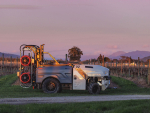
The Humus range of rotary mowers and mulchers are designed for use in the horticulture and viticulture sectors. The Humus range of rotary mowers and mulchers are designed for use in the horticulture and viticulture sectors.

Tractor and machinery importer and distributor Power Farming Group has extended its offering to the horticulture and viticulture sectors, with the launch of the Humus range.

Manufactured in Bermatingen, Germany, the business has been run by the Gotterbarm family since 1954 - specialising in rotary mowers and mulchers. Offering an extensive range, running to around 100 different models, its products are designed to meet the demands placed by differing topographies and growing techniques.

Manufactured using clever design and fine-grain steels, the company appears to have an exceptional reputation for producing machines that have long service lives and minimal running costs.

Looking at some of the range in more detail, the AFLR Series rotary mowers are offered in 1.8, 2.3  and 2.5 metre working widths. These machines are intended for front or rear mountin. A wide, linear side-shift system can achieve offsets of 63cm, while the drivetrain is comprised of a heavy-duty input gearbox and reinforced-belts.

An optional wing unit fitted to right hand extremity allows the machine to work automatically along a fence line or around the base of trees. The AFLR 3200 model offers a working width of 2.74 to 3.2m, using a parallelogram offsetting mechanism that offers a range of movement of 95cm.

The VO Series offers twin satellites, giving extended operating widths of up to 3.5m. The 3500-model works between 2.26 and 3.41m and up to 60cm of offset. Automated adjustment of the satellites is controlled by twin sensors that operate electro-hydraulically to guide the units around any obstacles. The configuration part of the machine has a smaller central disc, running ahead of the twin outer units.

The unique OMB Series has a triple rotor layout in 2.5, 3.0 and 3.5m widths. These are ideally suited to 'organically minded' operators by leaving a 40cm central "blossom strip" to encourage bees, butterflies, aphid predators and spider mites, which might be beneficial to the crop.

Looking at more classic configurations, the LV twin-rotor machines offer cutting widths from 1.10 to 1.8m that can be expanded laterally along a hexagonal drive shift by up to 55cm. Timed blades are configured to run at 89 degrees to each other. It comes with a range of options including spray packs with automated sensing systems, planetary heads to the side and wheel equipment for accurate cutting height control.

The STO is a low-profile series in 2.3 or 2.6m cutting widths,using a driveline with reinforced V-belts with a lateral offset of up to 151 CMS.

www.powerfarming.co.nz

More like this

Tractor Sales Fall in Most Major Markets Ahead of EIMA 2026

The market is in decline in the United States, Canada and Brazil. In Europe, sales are falling in Germany, France and Spain. Turkey is experiencing a sharp decline, whilst the economic strategies and policies implemented by India and China are driving purchases in both countries.

Waikato Dairy Family Uses John Deere Precision Tech

Areare Farms, a dairy operation in the Waikato region spanning multiple properties and milking 760 cows, now has Jenna and her brother Brian Rogers, the third generation of the family business, working alongside their parents Phil and Jackie.

SAM e-Spreader Now Connects Directly to Tabula

Hamilton-based manufacturer SAM Machinery and Hawke’s Bay’s Tabula have joined forces to offer customers more ways to connect its spreaders with the technology they already use in the cab.

Claas Balers Turn 30

Claas built its first variable chamber round baler - the Variant 100 - in 1996, so 2026 marks 30 years and the fifth generation of the Variant name, recently complemented by the new Cerex Series introduced in 2025.

Featured

Students' Strobe Light Targets Nesting Birds in Tractors

During the nesting season, from September to December, industrious starlings can quickly build nests in the darker areas behind tractor and vehicle, usually close to hot engines, typically resulting in localised damage or in some cases complete write-offs.

NZ Tractor Deliveries Up 5% Year to Date to September

With the last couple of months having seen some potential tractor purchases put on hold with the impending election and continued input cost rises, year-to-date figures, ending September, has seen deliveries up around 5% over the same period in 2025, with a total of 2026 units.

MPI's Diana Reaich on Non-Tariff Barriers and Trade Access

The head of the Ministry for Primary Industries (MPI) trade and international relations group says New Zealand is well-positioned to secure trade access and compete internationally as the world becomes more complicated, demanding and uncertain.

National

Machinery & Products

» Latest Print Issues Online

The Hound

'LinkedIn Greens'

OPINION: The same mainstream media muppets that brought you Jacindamania in 2017 have been flat out pimping for the Opportunities…

UK Warning

OPINION: Your old mate reckons the atrocious way farmers in the UK are treated by their lords and masters in…

» eNewsletter

Subscribe to our weekly newsletter