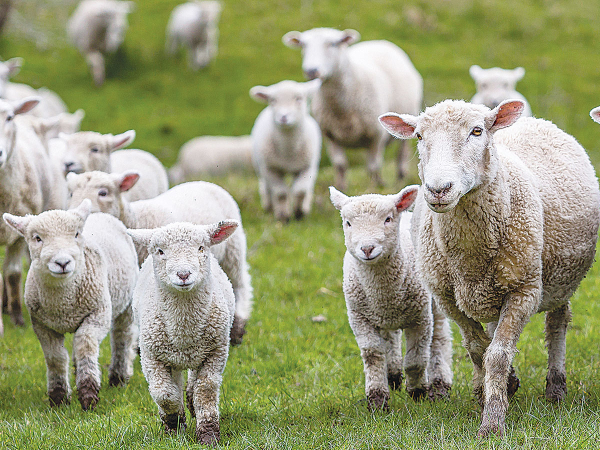
New research suggests sheep and beef farmers could improve both profitability and emissions efficiency by increasing lamb weaning weights, with only marginal changes in total greenhouse gas emissions.
The research, led by PhD candidate Joseph Adjabui at Te Kunenga ki Pūrehuroa Massey University, examined how higher lamb weaning weights affect productivity, profitability and predicted enteric methane emissions (methane produced during digestion).
While previous studies have focused on the production and financial benefits, this research also considers greenhouse gas outcomes, an increasingly important factor in farm systems decision-making.
Modelling Farm Performance
Using a system dynamics bioeconomic model, the study analysed a North Island hill country sheep and beef farm under three scenarios: a base system, a 10% increase in weaning weight and a 20% increase.
The modelling assumed a fixed feed supply, reflecting typical New Zealand pasture-based systems with limited supplementary feeding.
The results showed consistent improvements in farm performance as weaning weight increased.
Lamb carcass weight sold per hectare increased by approximately 2% under the 10% scenario, and 14% under the 20% scenario, relative to the base system. Cash operating surplus also improved, increasing by around 6% and 51% respectively.
Adjabui says the gains were driven by improved system efficiency rather than increased inputs.
“Heavier lambs at weaning meant more kilograms of lamb could be produced and sold earlier, improving both total production and farm income," he says.
Earlier Finishing Drives Gains
A key factor behind the improved performance was earlier finishing. Heavier lambs reached slaughter weight sooner, reducing time on farm and improving feed efficiency.
The proportion of lambs meeting prime specifications shortly after weaning also increased significantly—from 60% in the base system to 84% under the 20% scenario.
Because total feed supply was fixed, ewe numbers were adjusted slightly downward to balance demand, helping keep total emissions broadly stable. Predicted enteric methane emissions declined marginally from the base scenario as weaning weights increased.
While total emissions remained similar, emissions per kilogram of product improved, decreasing by approximately 1.8% under the 10% scenario and 3.6% under the 20% scenario. Economic emissions efficiency also increased.
“These results show there is no trade-off between profitability and emissions efficiency under this system,” Adjabui says.
One of the key drivers of improved performance is earlier finishing. Increasing weaning weight allows lambs to reach slaughter weight sooner, reducing time on farm, improving feed use efficiency and lifting overall system output.
PhD supervisor Emeritus Professor Steve Morris says the efficiency gains from earlier-finished lambs are clear when viewed at a whole-farm level.
“The most efficient lamb is the one sold directly to slaughter at weaning. It has been alive for fewer days, eaten less feed and required fewer animal health treatments, less labour and no shearing,” he explains.
“That feed is then available for other stock classes, improving overall farm performance. It is also often sold when prices are strongest, before peak seasonal supply.”