
Diplomatic Incident
OPINION: Your old mate hears an international incident is threatening to blow up the long-standing Anzac alliance as Kiwis and Aussies argue over who wants new Australian resident and former NZ Prime Minister Jacinda Ardern.




 increase font size
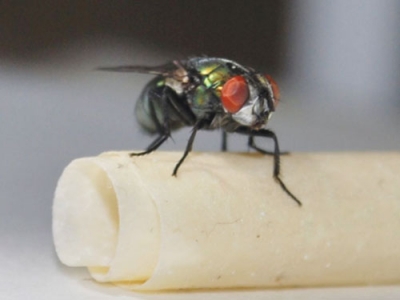 The sheep-killing Australian blowfly Lucilia cuprina has been genetically mapped by scientists. Photo credit: University of Melbourne
Scientists waging war on Australia’s nastiest agricultural parasite have mapped the blowfly genome in a development that offers the potential for new drugs and vaccine.
All 14,544 genes of the blowfly (Lucilia cuprina) were identified by the international research team, led by the University of Melbourne, including about 2000 genes not seen before in any other organism.
The blowfly is responsible for A$280 million in losses to Australia’s sheep industry each year from flystrike.
Published in the journal Nature Communications, the work provides insights into the fly’s molecular biology, how it interacts with the sheep’s biology and, importantly, shows its potential to develop insecticide resistance.
Blowfly maggots live on the skin of sheep and invade open wounds, where they feed on tissue and cause severe skin disease, known as myiasis or flystrike. It is an aggressive and notoriously difficult pest to control.
Lead researcher Clare Anstead of the university’s Faculty of Veterinary and Agricultural Sciences, says the genome map has limitless potential for fighting the blowfly at home and abroad.
“It is an extremely nasty parasite,” Anstead says. “The sheep is literally eaten alive. It’s horrific. The Lucilia species are responsible for more than 90% of flystrike in Australia and New Zealand.”
Anstead says the fly is especially good at evolving to resist insecticides.
“There has been a massive amount of research into prevention and control of flystrike, from developing a vaccine, new insecticides, to targeting weak areas of the fly, and even biological control with bacteria and fungi: none are completely effective,” she says.
Anstead says some of the 2000 genes never seen in any other animal or plant hold the key to the parasitic relationship between the blowfly and the sheep. “They could be targeted to develop a completely new method of control,” Anstead says.
Prof Phil Batterham of the university’s School of Biosciences says the gene map will allow researchers to predict gene mutation in flies that could make them resistant to chemicals.
“[It] means we may be able to avoid the type of crisis the medical community now faces with antibiotic resistance in bacteria,” he says. “The next step is to isolate the parasite’s ‘Achilles’ heel’ – genes that allow the parasitic interaction between the maggots and the sheep.”
Batterham says a vaccine that targets this gene could stop flystrike in its earliest stages.
“This vaccine could access vital proteins in the maggots, which would kill them,” he says.
Researchers now aim to use a powerful new technology called CRISPR to investigate switching off a number of genes, including the gene responsible for the blowfly’s extraordinary sense of smell.
OPINION: Your old mate hears an international incident is threatening to blow up the long-standing Anzac alliance as Kiwis and Aussies argue over who wants new Australian resident and former NZ Prime Minister Jacinda Ardern.

OPINION: Your old mate hears that at a recent China Business Summit, PM Christopher Luxon delivered a none-too-subtle "could try harder" report card on the red meat industry regarding its exports to China - particularly when compared to Australia.
More Australian states are embracing virtual fencing technology, opening growth opportunities for Kiwi companies like Halter.
Fonterra says its ongoing legal battle with Australian processor Bega Cheese won’t change its divestment plans.
Farmers in the Australian state of New South Wales will soon be able to use virtual fencing and herding technology to boost farm productivity.



Waikato milk processor Tatua has again declared a record milk payout to farmer shareholders, leaving other processors in the dust.

A Labour-led Government won’t be bringing back the controversial freshwater rules of 2020.
National’s much-touted free trade deal with India featured in the Rural Issues Debate at Mystery Creek, Hamilton on Wednesday night.
New Zealand's 2026-27 freshwater fishing season has opened, with anglers encouraged to head to rivers and lakes over the coming days as conditions look favourable across much of the country.
Central Otago District Council (CODC) has voted against a plan to spread treated sewage sludge from Cromwell and Alexandra on farmland near Lauder, a decision Federated Farmers says reflects strong opposition from rural residents.
Pāmu has released its FY26 Integrated Annual Report, reporting a Net Operating Profit of $113 million, more than double the $49 million recorded in FY25.





OPINION: The same mainstream media muppets that brought you Jacindamania in 2017 have been flat out pimping for the Opportunities…
OPINION: Your old mate reckons the atrocious way farmers in the UK are treated by their lords and masters in…




