
Pāmu FY26 Report: Profit More Than Doubles to $113m
Pāmu has released its FY26 Integrated Annual Report, reporting a Net Operating Profit of $113 million, more than double the $49 million recorded in FY25.




 increase font size
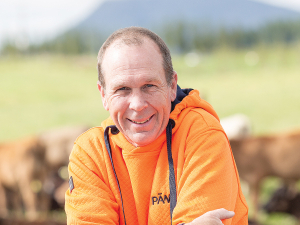
 Landcorp chief executive Steven Carden.
Landcorp is moving to farm more sustainably and reduce its carbon footprint, says chief executive Steven Carden.
It is replanting and reforesting: steep, hilly land is being put back into trees.
“There’s too much erosion; we can’t make enough money by putting a couple of sheep or a couple of beef cows there, and we face potentially a huge environmental bill coming in for methane gas,” he told the recent Environmental Defence Society ‘Tipping Points’ conference in Auckland.
“We need to get our carbon footprint looking much more responsible than it has been, which means putting back a lot more trees on more of our land.
“We are taking palm kernel out of our system because people don’t like that in farming; we actually don’t think it is a great way to farm. The numbers of farmers I’ve had approach me saying ‘thank goodness you’ve decided to do that’ has staggered me.
“We have just stopped dairy conversion, pulled back on a whole lot of plans to convert to more dairy.”
Carden says Landcorp is trying to think of alternatives to give a good economic return with a much lower environmental cost.
“We have started to walk the talk about farming more sustainably. But I think we have recognised as well that we will have to do more than that.
“Technologies are coming that will allow us to farm much more precisely than we have in the past. Big data and the technologies that come with big data are our friends,” he added.
“We can be much more specific now about the amount of nutrients and water we apply to the plants we plant to produce just the right growth we need to optimise productivity onfarm.”
Using home grown technologies like Farm IQ software allows Landcorp to farm by animal rather than by mob or herd.
“We can be much more productive with those animals by applying just the right amount of feed that they need at the right times to optimise their growth,” Carden says.
“It means a whole lot less wastage in the system, which reduces our environmental footprint.”
Pāmu has released its FY26 Integrated Annual Report, reporting a Net Operating Profit of $113 million, more than double the $49 million recorded in FY25.

A partnership between state-owned enterprise Pāmu (Landcorp Farming Limited) and charity Meet the Need is putting more than quality New Zealand beef into food bank parcels this year.
State farmer Pamu has delivered its strongest operating result on record.
State farmer Pāmu (Landcorp) has announced it will pay a $10 million special dividend to the Crown off the back of a strong outlook for the business and a capital repayment of $9.5 million following Fonterra's consumer business sale.
The Government has appointed three new members to the board of state farmer Landcorp Farming Ltd, trading as Pāmu.


Pāmu has released its FY26 Integrated Annual Report, reporting a Net Operating Profit of $113 million, more than double the $49 million recorded in FY25.

Meat Industry Association data, released alongside the Red Meat Sector conference in Wellington, shows export value climbing across the US, China, UK and Canada.
Applications are set to open for the 2027 Zanda McDonald Award, a trans-Tasman award recognised for identifying and fast-tracking talented young leaders in agriculture and agribusiness.
The Royal New Zealand College of General Practitioners (the College) and Hauora Taiwhenua Rural Health Network are calling for investment in a proposed new training pathway for rural GPs, warning that many rural practices are struggling to recruit while a large share of the existing workforce nears retirement.
Federated Farmers has called on Central Otago District Council (CODC) to drop or vote down a plan to truck sludge from Alexandra and Cromwell to farmland near Lauder, warning it would compound an "outrageous" situation created by a separate council's decision weeks earlier.
Synlait has swung to second-half profit as operations stabilise, but the dairy processor still posted a $75.4m annual loss.




OPINION: The same mainstream media muppets that brought you Jacindamania in 2017 have been flat out pimping for the Opportunities…
OPINION: Your old mate reckons the atrocious way farmers in the UK are treated by their lords and masters in…




