MPI Opens $3m Greenhouse Gas Research Funding Round
The Ministry for Primary Industries (MPI) has announced has opened applications for the 2026/27 funding round of the Greenhouse Gas Inventory Research (GHGIR) fund.




 increase font size

FEDERATED FARMERS representatives who have seen first-hand the potential for contaminated PKE to reach New Zealand fear an official Ministry for Primary Industry visit to Malaysia this week won’t resolve the threat.
Grains executive members Colin McKinnon and David Clark travelled to Malaysia last September for an official Palm Industry Board briefing; they also made an unofficial, unannounced visit to another plant, chosen at random.
They saw PKE in silos open to birds and other animals, and contamination was probable. Product would probably not have met New Zealand’s Import Health Standard, but the mill owner believed it was suitable for export to New Zealand and was willing to sell it to them.
Clark and McKinnon detailed their concerns in a report to MPI in November (Rural News, December 4 and February 19). Late last month, the ministry issued a statement saying it took Feds’ report very seriously.
“There are stringent safeguards in place that ensure PKE is safe for use, and MPI is requiring full assurance that these safeguards have not been breached,” MPI director plants, food and environment, Peter Thomson, said.
MPI has reviewed all documentation for PKE shipments from Malaysia since 2011, met Malaysian officials to ensure full understanding of New Zealand’s concerns, and arranged this week’s visit.
Last week nobody from MPI was available for interview about Federated Farmers’ concerns but in a written response to Rural News’ questions Thomson said two MPI officials would be in Malaysia May 20-27, then Indonesia to June 1.
No independent third party, such as a Federated Farmers representative, journalist, or representative of any other non-governmental organisation would accompany the officials as MPI claims this would not be appropriate.
“The visit is to ensure the government-to-government assurances provided by the exporting countries are underpinned by appropriately robust systems….
“New Zealand would not accept industry or media participating in importing country audits of our export systems.”
Asked what measures would be taken to ensure a true picture of the import pathways is gained, Thomson said MPI had determined and informed the Malaysian government officials where the officials want to visit. “This is standard practice for visits of this kind.”
He did not answer whether MPI’s officials would take a tour independent of their Malaysian counterparts and visit some PKE plants at random.
As for how New Zealand farmers could be confident they’re not importing a biosecurity risk onto their farms with palm kernel, Thomson said MPI would review all steps in the supply chain process from the manufacturing plant to loading at the port “to ensure there is sufficient confidence in the security of the supply chain, and there is no possibility for product to enter the supply chain and be consolidated with product intended for export to New Zealand.”
MPI later confirmed officials would physically inspect all steps in the supply chain at a number of facilities. It also said the findings of its visit, and which mills were visited, would be made public in an audit report.
Clark says he hopes MPI’s officials “get the full look and an honest appraisal of the supply chain” but recognises they will not be able to make an unofficial visit as he and McKinnon did.
The kiwifruit industry is paying the price with PSA for relying on MAF’s assessment of risk from pollen imports, he points out.
The Ministry for Primary Industries (MPI) has announced has opened applications for the 2026/27 funding round of the Greenhouse Gas Inventory Research (GHGIR) fund.

AMINZ and the Ministry for Primary Industries (MPI) have partnered to develop a new Farm Debt Mediation video series aimed at farmers, creditors, and advisors.
Dairy continues to be the mainstay of the country's primary export earnings.
Don’t worry about it but just be aware - that’s the message from Ministry for Primary Industries (MPI) director-general Ray Smith as the H5N1 strain of bird flu is found in Australia.
OPINION: The latest update from the Ministry for Primary Industries (MPI) on the state of NZ's primary sector paints a positive picturee about its performance over the past 12 months.


New Zealand dairy farmers are set to be the first in the world to receive access to a new digital physical milk pricing tool that enables them to fix the price for their physical milk.
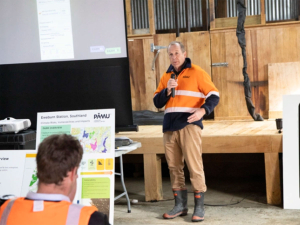
State farmer Pāmu is opening its farm gates this summer in an effort to give the rural sector the opportunity to see how large-scale, multi-system farming is delivering productivity and profitability across New Zealand.
A five-year study has found that the cost of reducing emissions without technology may be significant and unsustainable for Northland dairy farmers.
DairyNZ says Waikato farmers need certainty on Plan Change 1, but they say that certainty must be matched with practical, workable rules and a clear transition that doesn't get ahead of the new resource management system currently under review.
While the Government has moved quickly to make commercial hauliers' lot easier during the current fuel crisis, they appear to be stuck in the creep box when it comes to the agricultural industry.
Waikato farmers have been told that the Government’s new planning system legislation and the region’s Plan Change 1 (PC1) “won’t mesh together very well”.




OPINION: Central Hawke's Bay farmer Mark Warren recently told the Hawke's Bay Times it's time for a conversation about allowing…
OPINION: A nation that relies as heavily as NZ does on functional global shipping lanes will have to do its…