Got $1.5m for a bit of spraying?
While we are seeing more and more drones being used in New Zealand agriculture, we’re some way behind the US, where in places like the Midwest, the drones are certainly bigger than Texas.




 increase font size
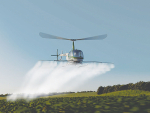
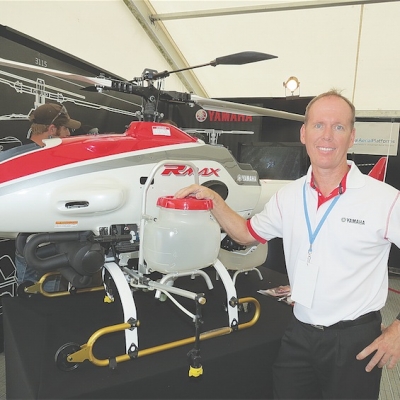 Yamaha RMAX UAV
It started off as a project to spray rice in Japan, now it could provide a solution to spot spraying noxious weeds on seemingly inaccessible places on New Zealand farms.
It looks like the perfect toy for any mechanically or technology-minded person; a mini helicopter no less, but not one you’d find in Noel Leemings or a toyshop.
The Yamaha RMAX UAV is a large unmanned aerial vehicle configured to spray weeds or drop fertiliser on places hard to access on foot or too small or uneconomical for a larger rotary or fixed wing aircraft.
The UAV was on show at the recent Wings over Wairarapa air show and was part of a large trade display of UAV’s. A sales rep for the UAV, Cory Hillsley, says its development began in the mid-1980s.
“The purpose was to minimise the risk of pilots doing small niche areas for spraying. It came into Australia about four years ago and this one on display is the first in New Zealand. We have plans to come here and do the same thing,” he told Rural News.
“We are looking at it first for spraying weeds such as gorse on steep and hilly terrain where larger aircraft would find access difficult. And also areas where it’s hard for people on the ground to get access.”
The RMAX can be fitted with two 8L tanks for spraying or two 13L tanks to hold granular fertiliser. It looks like a mini helicopter. Typically the RMAX would fly at up to 300m, but lower as required. In some ways, it’s a flying knapsack.
Hillsley says at present the operation of the UAV is manual, but the company is developing a GPS mapping system for the machine which would see it meet New Zealand requirements to have electronic proof of the exact area flown if the machine was spraying.
“We are developing one in Australia at the moment because we have the same requirements there. It’ll be a mapping solution and it’ll print out exactly where you fly and your flight path and it’ll change colour when you have operated the spray equipment.”
Hillsley says they are not trying to take any of the work off the bigger guys, rather targeting areas where there may be narrow and smaller spray buffer zones.
The company is working with CAA and hopes to start trials in New Zealand later in the year.
While we are seeing more and more drones being used in New Zealand agriculture, we’re some way behind the US, where in places like the Midwest, the drones are certainly bigger than Texas.
Agrichemicals can be one of the larger costs of crop production, so a new system from Amazone that suggests costs savings could be worth a look.
Drones may soon be joining the armoury of weapons used to scare birds away from ripening grapes after a trial undertaken in Hawke's Bay last season.
A clever light from Tyri will suit spray rig operators.
Drones’ (UAV) rising popularity has pointed to an inevitable tightening of the rules for their use as they evolve from remote control helicopters to sophisticated work platforms – especially in farming.

Penske Australia & New Zealand has appointed Stephen Kelly as the general manager of its Penske NZ operations, effective immediately In this role he will oversee all NZ branch operations, including energy solutions, mining, commercial vehicles, defence, marine, and rail, while continuing to be based at Penske’s Christchurch branch.
According to the latest Federated Farmers-Rabobank Farm Remuneration Report, released today, farm worker pay growth has levelled off after a post-Covid period of rapid growth.
The Climate Change Commission has recommended maintaining the current New Zealand Emissions Trading System (NZ ETS) settings but warns of a potential unit shortfall as early as 2028.
The Conservative Party warns that the upcoming free trade agreement between New Zealand and India may prioritise increased labour mobility while offering limited reassurance for New Zealand workers.
Southland District Council says it is actively managing the impacts of the current fuel supply challenges to ensure essential services across the district continue to operate safely and reliably.
A large crowd turned out for the last of the field days of the three finalists in this years Ahuwhenua Trophy to determine the top Maori horticulture entity in Aotearoa New Zealand


OPINION: When Donald Trump returned to the White House, many people with half a brain could see the results for…
OPINION: Media trust has tanked because of what media's more woke members do and say.