
Boosting Crop Production by Spreading Effluent
Tararua district farmer Jamie Harris milks around 400 cows using a split calving system on his farm, Crossdale Dairies.




 increase font size
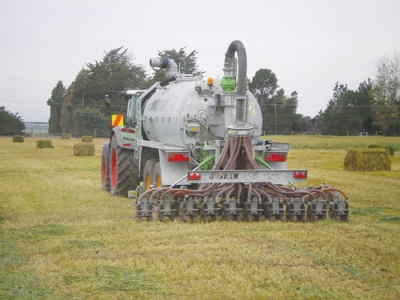 Injecting dairy effluent directly into soil has been found as the most efficient way of applying, with the least N losses.
New Zealand's farmers seem to have at last woken up and smelt the coffee.
They're realising that farmyard manure and dairy effluent have exceptional fertiliser value, and used wisely can greatly reduce inputs.
Many set-ups, particularly in the dairy sector, are being forced to meet increasingly tough environmental standards applied by local authorities; they are rightly concerned about runoff, groundwater contamination and destruction of local habitat.
Most 'new builds' must have a storage system to hold the effluent produced, particularly in wet seasons, and where ground conditions do not lend themselves to heavy traffic.
Unfortunately, the traditional method of application, centred on 'put it on thick lads, she'll be right' can result in two-thirds of the available N value being lost as ammonia emissions, losing the best part of the fertiliser value.
So it might pay to follow a lead from Europe: trials set up by the European Commission in 2013 looked at alternative methods of application and explored the best ways to reduce ammonia emissions.
These trials identified basically four ways to apply dairy liquid manures or slurries: the 'slap it on method', which resulted in losses of available N of up to 70%; application by dribble hose or trailing shoe applicators (losses 40% and 30% respectively); and shallow injection down to about 100mm (losses only 10%).
The findings mirror those in the Netherlands, which in the 1990s imposed mandatory injection for grassland. The results: ammonia emissions fell from 220 million kg in 1992 to 70 million by 1996 and 40 million kg by 2013.
So that foul smelling deposit excreted by Old Daisy – more often than not in the dairy shed when you're not looking – has serious potential to reduce input costs in these troubled dairy times. Stored properly and used wisely, with decent soil sampling en route, should help keep some businesses in the black.
Tararua district farmer Jamie Harris milks around 400 cows using a split calving system on his farm, Crossdale Dairies.
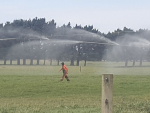
Water management is an integral component of sustainable farming practices, according to Watermetrics.
Two farmers and two farming companies were recently convicted and fined a total of $108,000 for environmental offending.
A Taupiri farming company has been convicted and fined $52,500 in the Hamilton District Court for the unlawful discharge of dairy effluent into the environment.
Founded in Germany as recently as 1977, today, the Fliegl Group employs more than 1100 workers, offering an expansive range of transport solutions, from their base in Bavaria.



Entries opened on Monday, 5 October 2026 for the 2027 New Zealand Dairy Industry Awards (NZDIA), which organisers describe as the nation's biggest celebration of excellence in the dairy sector.

Waikato milk processor Tatua has again declared a record milk payout to farmer shareholders, leaving other processors in the dust.
A Labour-led Government won’t be bringing back the controversial freshwater rules of 2020.
National’s much-touted free trade deal with India featured in the Rural Issues Debate at Mystery Creek, Hamilton on Wednesday night.
New Zealand's 2026-27 freshwater fishing season has opened, with anglers encouraged to head to rivers and lakes over the coming days as conditions look favourable across much of the country.
Central Otago District Council (CODC) has voted against a plan to spread treated sewage sludge from Cromwell and Alexandra on farmland near Lauder, a decision Federated Farmers says reflects strong opposition from rural residents.





OPINION: The same mainstream media muppets that brought you Jacindamania in 2017 have been flat out pimping for the Opportunities…
OPINION: Your old mate reckons the atrocious way farmers in the UK are treated by their lords and masters in…




