Mark Hooper Joins NZPork Board as Independent Director
Rural leader Mark Hooper has been appointed as an independent director to the NZPork board, bringing extensive farming, governance and advocacy experience to the role.




 increase font size
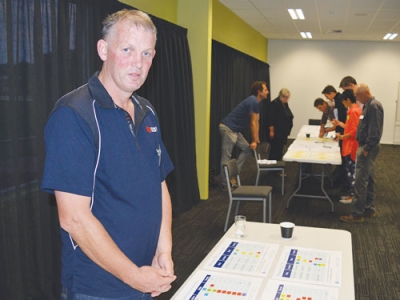 James Houghton at the Collaborative Stakeholder Group ‘drop-in’ session in Tokoroa.
Farmers in Waikato region need to be aware that change is coming.
Those farming well and minimising environmental impacts will be in a good place, says former Federated Farmers regional president James Houghton.
Houghton is urging farmers to put their ‘numbers’ through Overseer and work with professionals to understand how their businesses are impacting the environment.
“Hopefully farmers will look at changing behaviour and farming systems where required for better environmental outcomes without impacting the bottom line,” he told Dairy News at a ‘drop-in’ session at Tokoroa for the Waikato regional Collaborative Stakeholder Group (CSG). “Sometimes these environmental outcomes come on the profitable side.”
Set up two years ago to address water quality issues in the Waikato and Waipa rivers, the CSG is made up of farming community, environmental lobbyists and local government officials. It will, by November next year, recommend a plan change to the regional council and iwi to better protect the rivers.
This plan change will set targets and limits for land-based activities to help meet the water goals: contaminants from point sources (such as factories) and non-point discharges (such as farmland) will be considered by the CSG.
The Waikato region has about 2500 dairy farmers.
Houghton admits some farmers will see the CSG process as “interference in their business”. But we all live together in the community and have to work together, he says.
“It’s not about us and them but getting everyone on board. A lot of urban sewerage systems contribute to water pollution; it’s not farmers blaming towns. The ideal scenario will be coming up with recommendations that… everyone can live with.”
Houghton says out of the CSG process can come targets; these targets will grow into limits. “The process is to identify a pathway forward and sell that story to everyone in the community so they change their behaviour so we all live in the community and work together.”
Houghton’s successor as Feds Waikato chairman, Chris Lewis, recently called for a discussion on cow numbers and new conversions in the region; Houghton agrees there needs to be a discussion.
“In a catchment like this every new conversion adds pressure on the system; we are still waiting on the science but we can see that if we keep converting we are putting more load on the rivers.”
But Houghton says agriculture is not solely responsible for affecting water quality. “It’s the whole community that affects water quality.
“We agree that the more conversions in the upper catchment the more impact it’s going to have down river. But if all existing dairy farms dropped their numbers (nitrate leaching) and got good systems, perhaps there [would be] capacity for a few more cows.”
Houghton says the science behind water quality issues is still being worked on; the DNA of water E-coli is being established to identify where E-coli is coming from.
‘Grandparenting’ of water is being done to understand the age of water through the catchment. Some of the catchments have had dairying introduced only 10 years ago, Houghton adds.
“They might have an impact not now but 40 or 60 years down the track. Science is needed to get an understanding all throughout the catchment, then we’ll know what’s happening now and what will happen in future.”
A balancing act
On his Puketua farm, James Houghton is looking at autumn calving; at the same time he’s thinking about a wintering barn to offset the impact on environment.
“The move to autumn calving will have a greater impact on environment, according to numbers on Overseer,” he says.
“If I’m going to do that with economic side, I have to offset that by putting a Herd Home shelter which will have a lesser impact on the environment.
“So often we focus on the dollar; we need to shift the focus within farming commmunities so we start looking at the environmental side too.”
Rural leader Mark Hooper has been appointed as an independent director to the NZPork board, bringing extensive farming, governance and advocacy experience to the role.
Farms across the upper North Island are trialling different pasture mixes as part of a research programme that aims to build greater resilience into farming systems.
The terrible floods that hit the Wairarapa may have subsided, but the danger to farmers still exists, according to local Federated Farmers president Rob Hickson.
Will a stronger, more coordinated voice help rebuild confidence and improve returns in the wool sector?
Farms across the upper North Island are trialling different pasture mixes as part of a research programme that aims to build greater resilience into farming systems.
Election years are always a concerning time for farmers, according to DairyNZ chair Tracy Brown.
The Ballance Farm Environment Awards are coming to the West Coast of the South Island.
Most dairy regions around the country have had a pretty good season so far says Tracy Brown.
Rural leader Mark Hooper has been appointed as an independent director to the NZPork board, bringing extensive farming, governance and advocacy experience to the role.

OPINION: It seems Canterbury processor Synlait is still in the doldrums.
OPINION: Get offside with New Zealand First leader Winston Peters at your own peril.