Fonterra FY26 Results: $9.69 Milk Price, $3.4bn Profit
Fonterra has unveiled its annual results for the 2026 financial year, posting $27 billion in revenue and close to $20 billion returned to New Zealand farmer owners and unit holders.




 increase font size
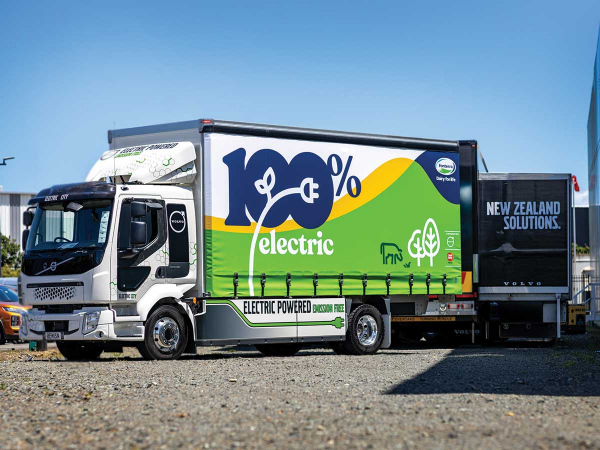 Fonterra's first electric delivery truck is now operating in Auckland.
Fonterra is using an electric truck for the first time to cart its products in Auckland and upper Waikato region.
The Volvo FL Electric truck is the first step by the co-operative to reduce its scope-one emissions, i.e. emissions that a company causes indirectly when the energy it purchases and uses is produced. In July, Fonterra also added its first fully electric milk tanker to its ranks.
The new Volvo FL Electric is powered by either a single 135kW/425Nm electric motor paired to a 600V system comprising four 66kWh batteries. It boasts a range of roughly 200km per charge, making it ideal for delivery runs within the city.
Fonterra took delivery of the truck last month as its Fonterra Brands NZ Distribution Centre in Mangere and it's now in use.
Fonterra Brands New Zealand managing director Brett Henshaw says that the new truck is an important step for the co-op as it looks to reduce emissions across its entire supply chain.
"Our objective is to fulfil our co-op's long-term commitment to be a leader in sustainability, while also upholding our customer commitments. It's great to partner with Volvo Trucks NZ, and one of the largest groups supporting the New Zealand transport industry, Sime Darby Motors NZ."
The new truck is one part of Fonterra's wider fleet decarbonisation plans. Last year it implemented a new policy that all light vehicles that can be transitioned when they are next replaced. Fonterra's aim is for more than 300 light vehicles to be electric vehicles by the end of 2023.
The co-op has 13 trucks that deliver products to supermarkets and depots in Auckland and upper Waikato. It also has 50 franchisees operating 180 trucks from its 35 depots across the country, carting products to dairies and service stations.
Fonterra says it is working with its franchises and helping develop a commercial case for them to eventually switch to electric trucks.
The Volvo FL Electric is the forerunner of a stable of sustainable alternatives from the global truck brand. Paul Illmer, vice president emerging technology business development at Volvo Group Australia, confirmed that Volvo has a battery electric or fuel cell electric alternative for every internal combustion engine (ICE) model on the market, either currently in production or at trial stage.
Illmer says that the actual truck is only part of the solution when it comes to New Zealand's transition to sustainable transport.
"Tools, expertise and infrastructure are essential to deliver operational peace of mind for New Zealand transport companies as they make the shift to e-mobility,” said Illmer.
“Selecting the right model and specification for both application and route is critical, as is driver training, specialist after sales support, and charging infrastructure.”
At the Volvo FLE launch event last month, the Volvo Trucks technical team demonstrated route planning technology and tools that support proactive route and battery management, giving transport operators confidence facing customer contract guarantees during their transition to more sustainable transport.
The Volvo Trucks NZ technical team has been preparing for electric trucks on the ground over the past year, flying to Volvo Global headquarters in Gothenburg, Sweden for intensive training.
Volvo says this allow the team to certify technicians on the EV decommission / commission process and train the Sime Darby Commercial After sales network on processes required to prepare workshops to service electric trucks and become authorised EV repairers.
Fonterra has unveiled its annual results for the 2026 financial year, posting $27 billion in revenue and close to $20 billion returned to New Zealand farmer owners and unit holders.

Fonterra Co-operative Group has confirmed the independently assessed candidates standing for election to its board in 2026.
Fonterra has revised its Farmgate Milk Price forecast for the 2026/27 season, lifting the midpoint and narrowing the range on the back of improving global dairy commodity prices.
Outgoing Fonterra Co-operative Council chair John Stevenson says that it has been a privilege to represent the co-op's farmer shareholders.
OPINION: It seems Canterbury processor Synlait is still in the doldrums.


Farmers across parts of Southland and South Otago are continuing to deal with difficult conditions after a prolonged run of wet weather, with pressure building around feed supply, stock management, pasture damage, farm infrastructure and everyday workloads.

Federated Farmers says it welcomes Labour's commitment to reviewing the Sharemilking Agreements Act, calling on other major parties to do the same.
For Canterbury dairy farmers Sian Meijer and Rick Wobben, wearable technology has become one of their most valuable on-farm tools - helping manage 1850 cows across an expansive, high-performing dairy operation while improving efficiency, mating outcomes and day-to-day decision making.
Fonterra has unveiled its annual results for the 2026 financial year, posting $27 billion in revenue and close to $20 billion returned to New Zealand farmer owners and unit holders.
The first major update to the Dairy Cattle Code of Welfare in more than a decade has been released, marking what DairyNZ describes as an important step in ensuring animal welfare standards continue to evolve alongside scientific evidence and on-farm realities.
Ravensdown shareholders have elected Jane Montgomery and Kate Acland to the Ravensdown Board for three-year terms, following a closely contested director election.


OPINION: It seems Canterbury processor Synlait is still in the doldrums.
OPINION: Get offside with New Zealand First leader Winston Peters at your own peril.




