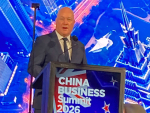
China No Longer Just A Commodity Story - Luxon
China remains New Zealand’s biggest market, taking $23 billion of our exports, but it’s no longer a commodity story, says Prime Minister Christopher Luxon.




 increase font size
 Yes, China is a big investor in NZ, but it is not the biggest.
KPMG’s latest research report on foreign direct investment in New Zealand gives perspective to much of the uninformed hype over this issue, in particular the emphasis on China’s role.
The report shows that of the $26.3 billion invested in NZ in the past two years the Chinese have invested $1.3b in dairy and milk processing.
While China is still a big investor it falls well behind the US, Canada, Australia and Europe and only just heads off Singapore. In land purchases, again the US (40%) heads the list, then comes Europe (14%) then China (13%).
Yes, China is a big investor in NZ, but it is not the biggest.
Perhaps China’s liking for our high profile, and quite sensitive, dairy industry is the cause of the feathers – especially political – getting ruffled.
Have Kiwis an inherent fear of China? This will suddenly switch to the US if Donald Trump by some amazing streak of stupidity gets elected as president.
We have not reacted to British investment after seeing that country doing itself bewildering self-harm by voting for Brexit.
Look at our neighbours Australia. A wave of Chinese investment in agriculture, housing and public infrastructure assets has also caused concern. Last year Canberra reduced the threshold at which purchases by foreign investors of farmland must be cleared by regulators from A$240m to A$15m.
New Hope is one of dozens of Chinese companies that have invested in Australia’s agricultural sector over the past few years. Chinese companies now own about 1.5m hectares of farmland. While that is less than 0.5% of Australia’s agricultural land, polls show rising public angst over sales of land to Chinese companies. In response, authorities have tightened foreign investment rules and this year blocked the proposed A$370m purchase of Kidman & Co by Shanghai Pengxin Group.
The KPMG report shows overseas investors view NZ agribusiness as a good place for their cash. They are not obliged to put it here, they can easily go elsewhere.
They target the dairy industry in particular, well ahead of forestry and wine and, to a lesser extent, sheep and beef.
If NZ is to produce high value niche products, it needs capital but the pool of capital here is insufficient to advance the cause.
Kiwis should be pleased that others can see opportunities for us to refine our base products and make them the Louis Vuitton’s of the food industry.
NZ still finds it hard to get away from producing commodities, sadly still lording that aspiration – a hangover from the days of the ‘number 8 wire’ mentality. Fred Dagg had it right: “we don’t know how lucky we are mate”. Right Trev?
China remains New Zealand’s biggest market, taking $23 billion of our exports, but it’s no longer a commodity story, says Prime Minister Christopher Luxon.
Fonterra is strengthening its foodservice presence in China with the launch of a new cream for professional bakeries at Bakery China 2026 in Shanghai.
According to new research, industry leaders have ranked world-class biodiversity as the number one priority for the 16th year in a row.
OPINION: What does the birth rate in China have to do with stock trading? Just ask a2 Milk Company.
Additional tariffs introduced by the Chinese Government last month on beef imports should favour New Zealand farmers and exporters.


Synlait has swung to second-half profit as operations stabilise, but the dairy processor still posted a $75.4m annual loss.

LIC shareholders have elected a new North Island representative to the co-operative's Board, along with five representatives to its Shareholder Reference Group (SRG), following the company's Annual Meeting held in Invercargill.
Farmers across parts of Southland and South Otago are continuing to deal with difficult conditions after a prolonged run of wet weather, with pressure building around feed supply, stock management, pasture damage, farm infrastructure and everyday workloads.
Federated Farmers says it welcomes Labour's commitment to reviewing the Sharemilking Agreements Act, calling on other major parties to do the same.
For Canterbury dairy farmers Sian Meijer and Rick Wobben, wearable technology has become one of their most valuable on-farm tools - helping manage 1850 cows across an expansive, high-performing dairy operation while improving efficiency, mating outcomes and day-to-day decision making.
Fonterra has unveiled its annual results for the 2026 financial year, posting $27 billion in revenue and close to $20 billion returned to New Zealand farmer owners and unit holders.




OPINION: It seems Canterbury processor Synlait is still in the doldrums.
OPINION: Get offside with New Zealand First leader Winston Peters at your own peril.




