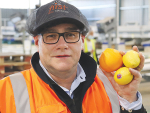
The work looked at the best times to pick and put product on the market. "There is nothing worse than picking too early and having immature fruit which doesn't taste good," says Ensor.
"The industry has worked on maturity standards, so the consumer gets a very consistent eating naval orange.
"Prior to the work there was only a 67% consumer acceptability of oranges. But over the 2020/21 period there was 95% consumer acceptability. That is fantastic. That means you've got repeat purchases, happy customers, and the opportunity to increase the value of your products."
Citrus NZ is also involved in a wider across-sector programme called 'A Lighter Touch' looking at agri-ecological methods.
"For citrus it is about putting down alternative plant species like flowering species amongst the trees to provide, for example, refuge for predator insects that eat pest insects. That's an exciting programme that started in the last year and will probably run for three or four years."
Industry contributes $17m to the programme which is industry led but also has significant MPI funding of $11m. A wide number of sectors are involved including kiwifruit, tomatoes, arable farming, onions, squash and grapes.
Ensor says Citrus NZ supplies growers with tools to grow profitably. Most of that sits behind the website in the members' portal.
"Considerable work is being done on grower guides whether that is nutrition, grafting or integrated pest management etc," he says.
"The ongoing research programme is where much of Citrus NZ's effort goes. Our research manager Dr Sally Anderson works from our Wellington office with scientists and organisations like Plant and Food Research."
The citrus domestic market is worth about $70m oer annum with a further $9m in export crop, mainly lemons. Japan is the largest market.
Citrus can offer opportunity for grower diversification.
"Citrus is a good crop to complement land and labour use. With most of our crops harvested in autumn and winter, citrus is perfect to follow on from summer or autumn harvested crops.
"In Gisborne citrus is harvested right through winter so can use the same people that harvested the kiwifruit or apples. You can hang on to your staff for longer. There are some good reasons for having citrus as part of your portfolio."
Citrus is mainly grown in Northland and Gisborne with a few other pockets where the weather is good. Northland extends down as far as Matakana north of Auckland, where mandarins are grown.
Satsuma mandarins are the main earners worth $22 million of the total $29m mandarin crop. Other citrus grown commercially are oranges, tangelos, lemons, lime and grapefruit.
About 3,000 tonnes of lemons are exported mainly to Japan. The industry is working on market access to other countries involving lengthy negotiations mainly on phytosanitary requirements. Two Asian countries are currently in focus.
Gaps in the import supply chain this year because of the crisis in transport logistics around the world have been partially plugged by domestic crop, says Ensor.
"Import programmes in the past year have been disrupted. The lemon imports which normally come in around Christmas (from California) were interruptedso the domestic prices remained higher than normal. Stored New Zealand lemons remained in the market and there weren't many of them."
This may present long-term opportunities for local growers. "There are about 15,000 tonnes of imports across all the varieties... that is seasonal so for that to be replaced we would have to find different varieties to widen the season. If we had more access to early or late varieties then you would compete directly against the import product. But it is not an easy thing to do and involves a breeding programme that takes a long time."
The industry is looking at it, he says, but cannot elaborate further at this stage.
Labour, especially right labour, is a big issue.
"If you have to duck in and out with casual labour you run the risk of not getting good labour. But it's fantastic if you can hang onto that labour.
"Citrus does not have a massive peak like kiwifruit or cherries which have to be picked over a few weeks. The harvest period is a few months so it is easier than some crops. But it is still difficult."
Citrus NZ works with MPI with a programme called Opportunity Grows Here, a campaign using social media and print (newspapers and billboards) which publicises seasonal work opportunities. Growers and packers are encouraged to then post their jobs on a website called PickNZ.
Overall the industry is stable. Some older citrus blocks are being pulled out in Gisborne to be replaced by higher value crops such as Gold kiwifruit or some licensed apple varieties. But in other areas growers are planting more citrus - for instance lemons in Northland.
Volumes are stable but prices have increased slightly in the past couple of years.
New Juice
Peter Ensor joined Citrus NZ in February following the departure of Rebecca Fisher who moved onto Horticulture NZ as a project manager.
Ensor was also with Horticulture NZ from 1999 to 2010 where he managed the Berryfruit Growers' Federation, the Fresh Produce Approved Supplier Programme and then NZ GAP, the Agrichemical Education Trust (GROWSAFE) and the Agrecovery Foundation.
Snce leaving HortNZ in 2010, Ensor was based in the United Arab Emirates delivering food security projects for the Government of Abu Dhabi, returning to New Zealand in 2020 due to the impacts of Covid.
Ensor returned to Wellington and is part of the team at Market Access Solutionz, managing Citrus NZ.