
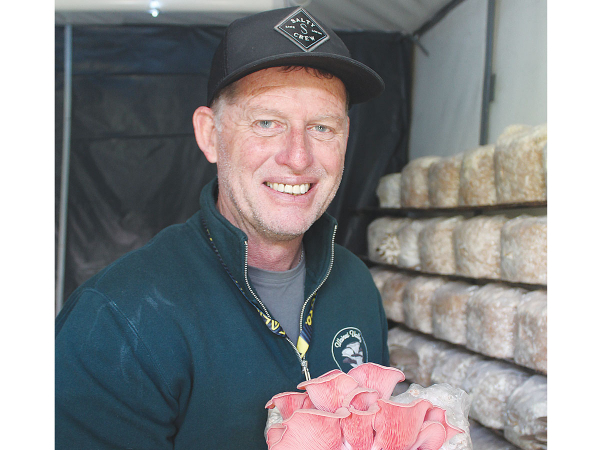

The long-time salesman is “still building his brand” of Wainui Valley Mushrooms and knows that marketing will be the key to the success of his venture. Cambier says while popular and well-known in Asian cuisine there is still much work to do in educating the Western palate on the delicate texture and mild, savoury flavour of oyster mushrooms.
While he and wife Bronwen both work off farm, Colin also does up to 30 hours a week on the mushrooms and Bronwen helps with sales.
So far, sales have mainly been through farmers markets, a speciality grocery store and food outlets. However, Cambier believes the potential is huge. A Raglan grower, he corresponds, with started in similar way and now has a thriving half-million dollar business.
One of the reasons Cambier selected oyster mushrooms was because of their culinary value and perceived health benefits.
“It is a big Asian thing, the Chinese have eaten those mushrooms for thousands of years for a particular reason,” he told Hort News.
Oyster mushrooms are claimed to be beneficial to the blood. Meanwhile, another type of mushroom Cambier grows, Lion’s Mane, is perceived as beneficial to the brain.
He says there has been a lot of research in the Asian world on the perceived benefits of mushrooms. While some Western research supports this, it is only a small body of research so far.
Cambier grows grey and pink oyster mushrooms and has recently started growing native oyster mushrooms. He gets native spores from Raglan and two varieties from a Northland supplier. Pink and grey oysters are a fan shaped and the native oysters are more of a trumpet shape. Lion’s Mane looks more like coral.
“The oysters are the easiest of the fancy mushrooms to grow. From start to finish takes 15 days with three or four processes involved,” he explains. “I do want to change up and bring some others in and with mushrooms there are so many possibilities. Turkey Tail also has a reputation for major health benefits.”
This is not a great eating mushroom but it can be ground up and mixed with things like Lion’s Mane in a capsule and Cambier says people spend a fortune on it. About 90g of ground Lion’s Mane can sell for $70.
Restaurants Tough Market To Crack
Cambier is certified to grow mushrooms but further qualifications are needed for dehydrating and other processing.
This may be further down the track for him. First he is focusing on his marketing with his upmarket looking packaging and point of sale material, social media and website.
He aims for quality and value for money and to create a business for his retirement. He doesn't want to chase the big supermarkets because as a "mushroom nut" he wants to maintain the integrity of his product which has a short shelf life.
Cambier wants to aim at the more exclusive fresh produce and grocery stories or into restaurants. However, despite some interest, he hasn’t cracked it with restaurants yet.
“Where I am doing quite well is these little pop-up kitchens, little coffee shops and stuff like that that make toasties,” he told Hort News.
"I work with an amazing young lady who also employs her sister and they get up at 4am and sit on the roadside at Waitoki with a container called Mini Oak. They catch logging trucks at 4.30am with coffees and food; she has a commercial grade kitchen at home. At 5.30am she catches all the tradies off to work and at 7.30am she catches the mums dropping their kids off at school. She has a thriving little business and good on her.”
Food outlets which do things like toasties, quiches and baked goods are perfect for his product where the mushrooms are the star of the show.
He believes his mushrooms could well catch on with restaurants as they are perfect for experimentation for budding chefs. It is something different to what they would find on supermarket shelves.
To make his website more interactive he wants to start encouraging people to send in recipes and perhaps have a competition. One of his regular customers uses them in Miso soup.
Cambier says he is all about community and wants his local producers to work together. In Weranui Rd for instance there is a free range egg farm, a deer farm, an organic dairy from, an olive oil producer, a tea tree oil producer and a bush trails outfit to name a few.
As a start, a group of small business owners are getting together on the last Friday of every month to share ideas and resources.
Home grow kits are another side-line to his business. He is sticking to the oyster mushrooms because they only take 15 days – the grey, the pink and the native oysters.
“I’ve had a lot of inquiries for Christmas – it’s an unusual gift for those who have everything. It doesn’t take much work at all.”
The mushroom waste makes “fantastic” compost and he is booked three months in advance for that.