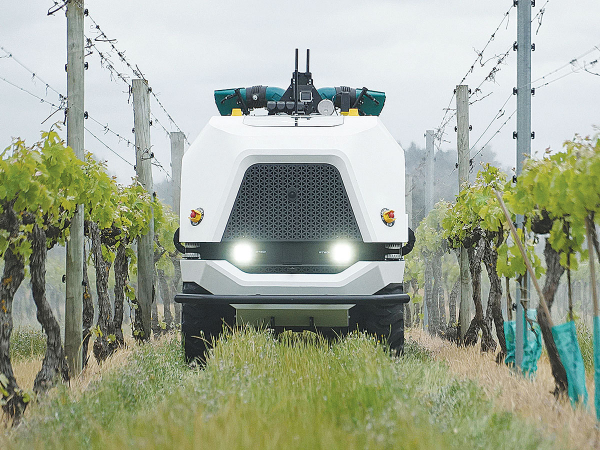
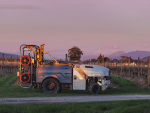
Tauranga-based Robotics Plus has launched its autonomous multi-use, modular vehicle platform for agriculture.
It is designed to carry out a variety of orchard and vineyard tasks and help to alleviate ongoing labour shortages within the industry.
The multi-purpose Unmanned Ground Vehicle (UGV), which can be supervised in a fleet of vehicles by a single human operator, uses a combination of vision systems and other technologies to sense the environment. Growers will be able to rotate multiple tools on the adaptable platform, depending on the day’s work, carrying out jobs such as spraying, weed control, mulching, mowing and crop analysis.
“We’ve created a flexible agricultural platform with the power to adapt to different crop types with tools for various applications,” says Steve Saunders, co-founder and chief executive of Robotics Plus.
“Providing year-round automation benefits and maximizing machine utilisation.”
Said to deliver growers and orchardists automation that solves real-world problems, the vehicle reduces reliance on costly and hard-to-find machine operators, while also providing data-driven insights for informed decision-making.
The first application for the technology is intelligent spraying, adapting flow rates to ensure spray efficacy whilst reducing inputs. This is achieved by adjusting spray rates and airspeed in controlled zones as the sprayer moves along orchard or vineyard rows.
Highly manoeuvrable, with a small footprint and unique steering configuration, incorporating independent motors, the UGV can be operated in a range of crops with a minimum row spacing of 1.8m.
This allows for more ground to be covered than machines, which turn on every second row or greater.
Featuring a hybrid electric-diesel drive train, the former offers superior torque and control, whilst a Tier 4 diesel generator means the vehicle can operate for extended periods. Fuel consumption is minimised by electrically driving all systems, including tools.
Regenerative braking and high-capacity batteries also extend efficiency and range. Additionally, the vehicle’s lightweight design and intelligent all-wheeldrive system, with independent wheel motors to ensure grip and control, all reduce ground compaction.
The vehicle has been designed from the ground up to be modular and easy to service.
It has no hydraulic, gearbox or differential fluids to be managed, with vehicles kept running if a part fails by simply swapping out modules when required. Component suppliers include Yamaha, Autonomous Solutions and Croplands, who will offer support in the field.
Robotics Plus developed the modular platform UGV at its Tauranga base, with extensive testing in New Zealand and the US in various environments and applications. Robotics Plus investors include Yamaha Motor Company and New Zealand’s ACC Impact Fund.
www.roboticsplus.co.nz/