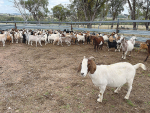
New export records for Aussie goatmeat
The Australian goatmeat industry set a new record for production and exports last year.




 increase font size
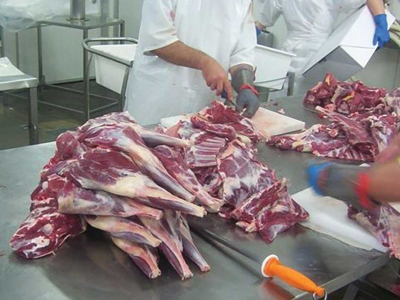 NZ meat exporters have not capitalised on the growing Northern American demand for goat meat.
Long-time goat industry advocate Garrick Batten questions why NZ meat exporters have not capitalised on the inbuilt and growing Northern American demand for goat meat.
This is despite goat meat's historically increasing prices. He also asks is why NZ pastoral farmers have not capitalised on the on-farm production advantages to produce that goat meat?
China already has the world’s biggest sheep flock; sheepmeat is well known so NZ product sales – especially mutton – have grown rapidly in recent years.
There are as many goats as sheep in China, all ending up as meat that is interchangeable with sheepmeat in the market. But our Chinese trade never mentions goat meat.
The USA that is now our second most valuable red meat market, with sheepmeat exports up 12% and nearly $NZ 3 per kg for year ending. September 2019. Last October, average price per kg was NZ$18.97 compared with China’s $NZ 9.32 – although products are not directly comparable.
The US sheep flock is slowly declining – as it’s goat herd, which supplies only half market demand. Similarly; our US meat trade never mentions goat meat.
Average Australian 2019 goat meat over–the–hooks (OTH) carcase price was $A7.90 per kg for 8.1+ kgs. In December, it was $A8.22. Thomas Foods Intl – Australia’s largest meat exporter – offered $A9 per kg for 6.1+ kg – down from $10 last spring. (Currently, the NZ schedule is around $NZ5.50 for 8.1kg+).
The importance of the USA and similar Canadian markets and opportunities for goat meat deserves closer scrutiny – particularly as Thomas Foods targets these markets.
In November 2019, USDA retail market average $US prices per lb for three typical grassfed goat products were bone-in-leg: 13.33; stew meat: 12.30; ground meat: 11.26. This compared with grass-fed lamb at 13.73; 13.85 and 13.01 respectively. These retail prices indicate similar buyer interest and prices for the two products.
The current US sheep situation reflects cancellation of the mohair subsidy by an earlier Democratic government, which removed angora goats from the main production area of Texas and other southern states. These have been gradually replaced by hair sheep – now quoted separately from wool sheep at auction.
In May last year, lightweight slaughter hair lambs sold for 3.5% premium over wool breeds. However, similar weight kids sold for a 25% premium over hair lambs. In October, the premium was 29%.
This means that a 25kg liveweight, good store condition kids sold for average $US5.87 per kg. This reflects an average industry live sale price for well-conditioned kids during 2019 of about $US3 per lb to produce those retail prices. Canadian live sale prices are similar.
The North American goat meat market shortfall is filled mainly by Australian imports of larger carcases than smaller 11-15 kg carcases preferred by Hispanic and other ethnic consumers, which NZ can supply from feral-based stock. Although Australia exported about twice as much lamb as goat meat to USA last year, its goat meat exports were 20 times those from NZ at much higher prices.
About the author
Garrick Batten has a long professional and practical career in all goat sectors. He has delivered papers at local and international conferences on various goat topics and written extensively, including several goat books. The latest is Big Buck$ for Pastoral Farmers, written specially for livestock farmers new to commercial goat farming. https://www.copypress.co.nz/real-nz-books
The Australian goatmeat industry set a new record for production and exports last year.

Last month's inaugural New Zealand Cashmere Conference saw the opening of a new fibre processing facility.
Hill country farmers cannot ignore the goat meat market opportunities such as in North America, according to goat farming expert Garrick Batten. He outlines why in the third of his three part series on the topic.
The US goat meat market provides profitable potential for NZ hill country farmers, in Garrick Batten's opinion. From his extensive industry background, he discusses this potential in the second of three articles.
Former All Black Kevin Schuler says diversifying the family farm with his brother Paul into three milking systems – cows, goats and sheep – is all about creating a better and stable business.


High country stations, mixed sheep and beef farms, Māori-owned farms, corporates and family operations are among the nine commercial farms taking part in the Livestock Innovation Farming Transformation programme, known as LIFT.
OPINION: New health and safety guidance unveiled by the Government recently provides farmers greater certainty about what is expected of them when managing risks on farm.
The National Animal Welfare Advisory Committee (NAWAC) is seeking public feedback on proposed changes to the Code of Welfare for Rodeos.
A New Zealand initiative supporting farmers to restore the health of grazing landscapes has received international backing through the Regenerative Fund for Nature, a global collaborative fund supporting regenerative agriculture and the communities that produce natural fibres for the fashion industry.
Combine premium New Zealand products, blend in a family ritual and what do you get? A world-class functional drink.
Entries are now open across eleven regions for the 2027 New Zealand Dairy Industry Awards (NZDIA).




OPINION: The same mainstream media muppets that brought you Jacindamania in 2017 have been flat out pimping for the Opportunities…
OPINION: Your old mate reckons the atrocious way farmers in the UK are treated by their lords and masters in…




