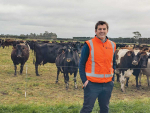
New Dairy Holdings CEO Backs Self-Contained Model
Running a tight and self-contained ship is the key to the success of the country's largest dairy farmer, says Blair Robinson, the new man at the helm of Dairy Holdings.




 increase font size
 Pictor chief executive Howard Moore.
A small, Auckland research firm is developing a more sensitive test for Mycoplasma bovis.
The test could play a critical role in accelerating the eradication of the disease from New Zealand and preventing another incursion.
Biotechnology company Pictor recently concluded a research agreement with the M. bovis Programme (Ministry for Primary Industries, DairyNZ and Beef + Lamb) to fund the development of a more sensitive diagnostic tool for M. bovis.
Pictor chief executive Howard Moore told Rural News the current M. bovis test is not as sensitive as it could be.
The company has collaborated with the University of Melbourne, which Moore claims is the world’s leading expert in M. bovis research, to develop a more sensitive test for the disease which will have five biomarkers instead of just the one in the current test. This means from a single sample of milk there will be more informed diagnoses of M. bovis through the detection of multiple biomarkers. The new test will also reduce the analysis costs, complexity, and sample volume.
“The more sensitive a test the more reliable it is in picking up the disease,” Moore explained.
He says the current M. bovis testing produced a number of false negatives meaning herds infected with the disease are not easily detected.
“Our test technology detects more immunogenic biomarkers and will make it easier to identify M. bovis in infected herds,” Moore told Rural News.
Pictor and the University of Melbourne plan to develop a diagnostic test capable of simultaneously detecting antibodies against multiple M. bovis antigens, rather than detecting only antibodies against a single antigen, as is the case in existing commercial testing.
Moore says NZ has more data on M. bovis than anywhere else in the world.
“In biotechnology, the more data the better,” he explains.
Meanwhile, chair of the M. bovis advisory group and MPI’s chief science adviser John Roche says the development of a more sensitive M. bovis test has the potential to optimise future testing for the disease.
“The current testing regime is good for this stage of the eradication programme. However, in 12-18 months as the prevalence of the disease in the cattle population gets lower and lower, the ability to detect it will get harder and harder.”
Roche says better testing will play a critical role in accelerating the eradication of M. bovis from New Zealand and in preventing another incursion.
Moore says while Pictor will be developing the testing kits, MPI will still be carrying out the actual testing.
He estimates the new testing kits will be available by June or July 2021, and these will be 100% manufactured in NZ.
Not just cows!
Pictor also has plans to develop a test for detecting COVID-19 infection that will give a result in less than an hour.
Chief executive Howard Moore says current diagnostic testing in New Zealand for COVID-19 is slow, complex, expensive, and must be done in a specialist central laboratory.
“We are developing a new diagnostic test to detect SARS-CoV-2 infection at all stages of the COVID-19 disease,” Moore says. “It will involve the simultaneous detection of specific biomarkers involved in different stages of infection, enabling early diagnosis of infected patients, including asymptomatic patients.”
He says the test will be fast (taking less than an hour), cheap and will not require specialist infrastructure. “This makes the new test ideal for deploying globally, including remote locations, decentralized labs and developing nations.”
Moore is hoping Pictor will have the new test ready for clinical trials within six months and available for use in 6-12 months.
Running a tight and self-contained ship is the key to the success of the country's largest dairy farmer, says Blair Robinson, the new man at the helm of Dairy Holdings.

OPINION: It's no surprise that "world-class biosecurity" continues to dominate as the top priority for agribusiness leaders, holding the number one spot for the 16th consecutive year in KPMG's latest agribusiness report.
Compensation assistance for farmers impacted by Mycoplama bovis is being wound up.
New Zealand's world-first Mycoplasma bovis eradication programme is making great strides but this isn't the time for complacency, says Ospri.
A national pest management plan to eradicate Mycoplasma bovis (M. bovis) will come into effect by the end of this year.



National’s much-touted free trade deal with India featured in the Rural Issues Debate at Mystery Creek, Hamilton on Wednesday night.

New Zealand's 2026-27 freshwater fishing season has opened, with anglers encouraged to head to rivers and lakes over the coming days as conditions look favourable across much of the country.
Central Otago District Council (CODC) has voted against a plan to spread treated sewage sludge from Cromwell and Alexandra on farmland near Lauder, a decision Federated Farmers says reflects strong opposition from rural residents.
Pāmu has released its FY26 Integrated Annual Report, reporting a Net Operating Profit of $113 million, more than double the $49 million recorded in FY25.
Meat Industry Association data, released alongside the Red Meat Sector conference in Wellington, shows export value climbing across the US, China, UK and Canada.
Applications are set to open for the 2027 Zanda McDonald Award, a trans-Tasman award recognised for identifying and fast-tracking talented young leaders in agriculture and agribusiness.



OPINION: The same mainstream media muppets that brought you Jacindamania in 2017 have been flat out pimping for the Opportunities…
OPINION: Your old mate reckons the atrocious way farmers in the UK are treated by their lords and masters in…




