
Federated Farmers Welcomes ACT’s New Farming Policies
Federated Farmers has welcomed new rural policies released by ACT, saying they align closely with its own election priorities.




 increase font size
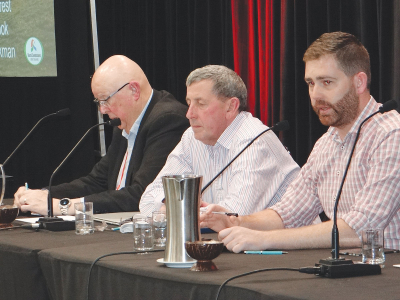 Left to right: RCNZ’s Roger Parton, Fed Farmers’ Gavin Forrest and MPI’s Joe Stockman at the RCNZ Nelson conference.
Rural contractors have challenged MPI and Federated Farmers over the management of Mycoplasma bovis.
At the Rural Contractors NZ conference, held in Nelson last month, re-elected RCNZ president David Kean led the questioning on disease.
He says a second round of M. bovis was being suggested on some Southland farms and contractors were no better off than the first time in knowing whether a farm was infected or not.
Kean added that using TracMap, contractors like him could visit three farms a day without direct contact with a farmer, raising the risk of spreading the infection. Taranaki’s Chris Satherley claimed that MPI had put contractors in a terrible position and if eradication was sought, the names of affected properties had to be communicated.
Federated Farmers general manager for policy and advocacy, Gavin Forrest, told the conference that all farms with infected herds were required to have signs on their gate and it was traumatic enough for farming families without the risk of victimisation.
RCNZ chief executive Roger Parton explained that contractors had to travel from farm to farm, so knowing which farms were suspected of having M. bovis would allow them to take appropriate measures and not expand the risk. Forrest said if contractors were washing down equipment between farms the chances of spread were virtually nil.
MPI’s Joe Stockman told the conference the primary sources for transfer were cow-to-cow contact and contaminated milk. He also claimed some farmers had not given a “sh!t” about keeping NAIT records, which had not helped.
Stockman added that 176 properties were under investigation for M. bovis, making it the most challenging biosecurity issue farmers had ever faced.
But he pointed out there were 22,000 farms nationally and fewer infected dairy herds were emerging and the disease was not moving into beef herds.
The conference was told farm biosecurity issues were not limited to M. bovis. Helen Slattery, who sits on a national committee dealing with velvetleaf, said some farmers had been driven near to suicide over the invasive pest.
Federated Farmers has welcomed new rural policies released by ACT, saying they align closely with its own election priorities.

A farmgate milk price of $10/kgMS this season is firming up as milk powder prices soar and the New Zealand dollar weakens.
Federated Farmers is backing Feilding High School’s call to keep Agriculture and Horticultural Science as a standalone subject in Year 11.
National’s pledge to introduce 19 new national standards shows the party is serious about getting Wellington out of farming, Federated Farmers says.
Mobile phone coverage and reliability are deteriorating in rural areas, and farming families are bearing the cost, according to a Federated Farmers survey.


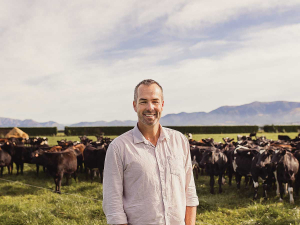
For Canterbury dairy farmer Cameron Henderson, supporting Meet the Need comes down to a simple question: how can the success of New Zealand farming benefit more than just those within the industry?
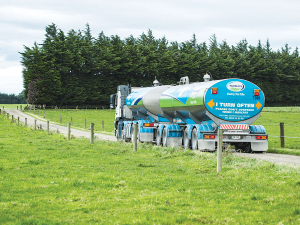
Fonterra board members are in line for a pay rise of around 3%.
Dairy processors are ready to further boost New Zealand’s export earnings but want the incoming government to match their ambition with good policy.
Massey University is best placed to solve the “problems” facing the dairy industry, says vice chancellor, Pierre Venter.
Synlait's longest serving employee – a man who joined the Canterbury-based milk processor even before it began processing milk – is now its newest executive.
A dairy industry leader believes eradicating the common and costly disease, Bovine Viral Diarrhoea (BVD) is within reach.




OPINION: The same mainstream media muppets that brought you Jacindamania in 2017 have been flat out pimping for the Opportunities…
OPINION: Your old mate reckons the atrocious way farmers in the UK are treated by their lords and masters in…




