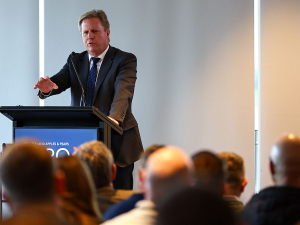
ENVIRONMENTAL POLICIES, and indeed market forces, are set to change the way we farm whether we like it or not so wake up and get engaged in the process, delegates were told at last week’s South Island Dairy Event.
Several keynote speakers gave stark warnings about how policies aimed at protecting water quality are rolling out around the regions and will impact output.
They included Taupo beef farmer Mike Barton who relayed how, after 12 years of collective negotiation and court proceedings, he and 104 other farmers in the lake’s catchment had come to terms with a nitrogen cap. “I’m not here to make friends but to wake you up to what’s going to happen to you,” he told the 580 conference delegates.
Along his road alone the cap has seen four farms planted in pines, and the families that used to live there lost from the local economy and community.
But not even 20% of the Taupo catchment was farmed, so in the rest of the country, where more like 90% of the landscape is farmed, the social and economic impacts of such policies will be “an order of magnitude greater,” he warned.
With the benefit of hindsight, he says farmers shouldn’t even talk about [environmental] solutions until they “deeply understand” the science behind the policies, and there is concensus on that science. Nor should they enter into talks about solutions without having the economic impacts of what’s being proposed “nailed down.”
All farmers need to engage in the process, act collectively, and understand the drivers. Leaders will be needed. Those leaders mustn’t be the traditional table-thumping, property rights-rant type, he says.
“You need someone who is going to tell you what you need to hear, not what you want to hear. And once they are elected, you need to support them because they will go through a hell of a lot.”
Unity within farming as a whole, not just as sectors, is the key, he believes. “We wanted this to be a dairy problem, but we all need to work together because we’re all part of it. Sheep and beef farmers are grazing dairy heifers; you buy seed from arable farmers.”
Consumers also need to be made aware they are part of the environmental problem, and indeed the solution. “Eating, in my view, is the final step in the agricultural process. As farmers we are the first step. The consumer cannot be divorced from that process.”
Barton’s solution to reduced output caused by nitrogen limits is branded beef, marketed it on its traceability, environmental sustainability, and premium quality.
“As a nation we cannot continue to occupy the commodity space and impose emissions caps on our producers at the same time.”