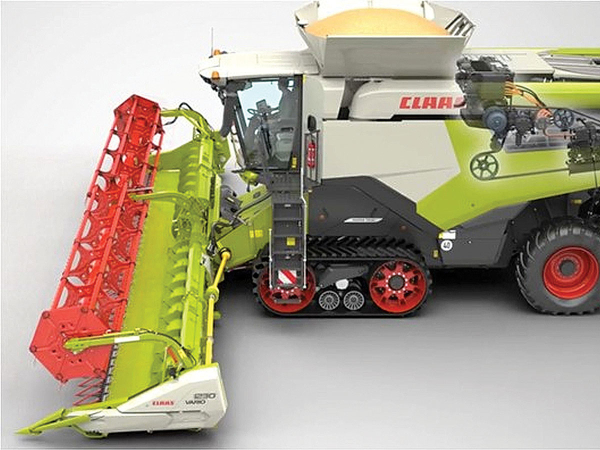
Harvesting and tractor specialist Claas has developed and field tested a combine harvester fitted with a part electric drive system.
In addition, working with fellow German company Liebherr, it has also developed a 100% electric telehandler.
The semi-electric combine, concept allows self-propelled machines that would normally be powered by a 626hp (460kw) powerplant to run on a less powerful 536hp (400kW) engine. A further benefit is that the smaller engine can operate at 1600rpm, instead of the normal 1800rpm.
This smaller engine and reduced speed is compensated for by a 40kW electric motor, that in more power-hungry situations, such as in high-yielding areas, travelling uphill or emptying the grain tank, provides the mechanical driveline with a short term electric power boost.
Replacing the conventional maximum output provided by the diesel block, the electrical support enables peak loads to be bridged, allowing the combine to consistently operate in the optimum performance range.
Flattening peak loads, the hybrid concept is claimed to reduce fuel consumption by up to 10%. In easier conditions where the full power of the diesel engine is not needed, a generator provides a regenerative function, converting excess power into electricity to be stored in the 3kWh battery.
The semi-electric system operates in the low, sub 60v range, so does not require the complex safety precautions associated with higher-voltage drives. Claas says that this means maintenance can be carried out without any special training. At this stage, the project is still at the early concept and testing stages, and it is not yet known if the system will make it to the production stage.
In other Claas news, the company is the latest to approve hydrogenated vegetable oil (HVO) for its products, although it is already widely marketed as a direct drop-in replacement for diesel fuel.
However, the company notes in its latest bulletin that while battery power may be suitable for lighter applications, an electrically powered Jaguar forage harvester would need to be twice the size and weight to provide the same power and range as the current diesel models, so for the foreseeable future, “traditional” fuels will continue to be important.
Keeping the diesel engine as the primary power source is seen as essential by the company. Dr Martin von Hoyningen- Huene, who heads the tractor division, notes that “there are no real alternatives to the combustion engine for high-performance agricultural machines in the foreseeable future”.
The company also states that gaseous fuels such as methane or hydrogen also have significant disadvantages in terms of their energy density and thus their energy storage requirements, while the infrastructure for supply and storage of these materials is still a long way away.
It would appear that for now, Claas has decided that there is no other viable or convenient method of supplying energy to a tractor, hence the company’s full backing of HVO as fuel to help reduce carbon emissions. From October 1, the company states that all tractors and harvesters leaving Le Mans will be fuelled at the factory with HVO and that Claas fully recognises it as a substitute for mineral-sourced diesel.