Greendrill, a red-hot performer
Dubbed as a universal seeder, Amazone’s new GreenDrill 501 is said to be ideal for one-pass sowing of ‘catch crops’, fine seeds and undersown crops in combination with the company’s trailed cultivators.




 increase font size
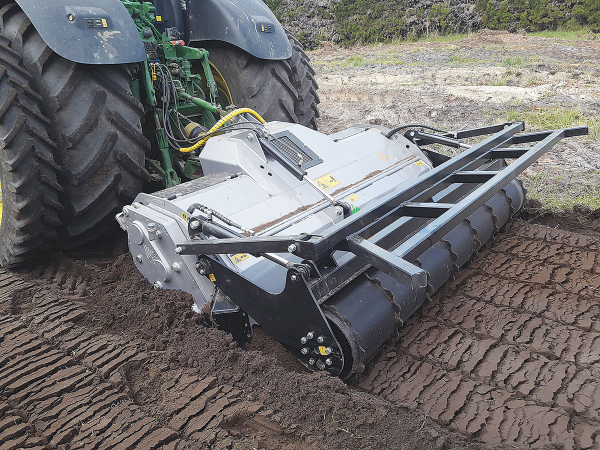 Active VMA's FAE heavy-duty trash cultivator.
Active VMA's FAE heavy-duty trash cultivators have developed a following amongst contractors in New Zealand.
Active VMA is a Rotorua-based engineering business that specialises in roading, forestry, agricultural and construction equipment.
The company offers the FAE product range as a key part of their offerings. FAE group is an industrial equipment manufacturer based in northern Italy, who over the last 30 years have used their research and development department to become an industry leader in heavy-duty shredding and mulching machinery.
FAE heavy-duty trash cultivators have developed a following amongst contractors in New Zealand who specialise in converting recently cleared forestry and old scrub blocks back into productive land.
Until recently, timber remnants or slash from cleared forestry blocks, has been left to gradually break down. This has a potential to pose a serious environmental risk.
One only has to look at the problems caused in the East Cape last year, with “slash” blocking waterways, while also extending the time to bring the land back into productive use. Similar problems have also been seen Gisborne – with slash blocking waterways, therefore taking longer before blocks can return to productive land use.
By using a FAE cultivator to clear the organic material that remains after harvesting, the remnants are shredded and fully incorporated into the cultivated soil. This helps organic material to break more rapidly, while also returning nutrients to the soil profile to give following crops a head start.
“Although taking the extra step to properly clear forestry land after harvest requires more time up front,” explains Ray Copland from Active VMA. “It actually saves landowners time and money by ensuring a block is ready for a second forestry rotation or another crop much sooner.”
He says the practise helps eliminate the potential environmental risks caused by the huge volumes of debris left post-harvest.
FAE cultivators range from a working width of 1.5m to 2.5m to suit tractors from 100-hp to 500-hp.
The machines can shred timber up to 450mm -diameter, crush stones up to 350mm and offer a maximum working depth of 500mm – depending on model.
Dubbed as a universal seeder, Amazone’s new GreenDrill 501 is said to be ideal for one-pass sowing of ‘catch crops’, fine seeds and undersown crops in combination with the company’s trailed cultivators.
Dubbed as a universal seeder, Amazone’s new GreenDrill 501 is said to be ideal for one-pass sowing of ‘catch crops’, fine seeds and undersown crops in combination with the company’s trailed cultivators.
Well known for making power harrows, rotary hoes, sub-soilers, mulchers and combination drills, Alpego has for 45 years used Swedish steel in delivering machines of high quality and durability.
CB Norwood Distributors, importers of Vaderstad cultivators, has launched the maker’s Carrier L and XL cultivators.
The Kverneland CLC cultivator has been around for a number of seasons.



Federated Farmers has welcomed new rural policies released by ACT, saying they align closely with its own election priorities.

Rural Contractors NZ says proposed changes to land transport rules for agricultural vehicles are a welcome response by the Government to out of date regulations which have seen members hit with huge fines.
Alliance is calling for final applications for its 2027 Graduate Programme, with applications closing on Sunday 25 October.
Decades piloting planes has ensured vet and farmer David Hayes is focused on safety. So, after a serious accident while welding on farm, he is sharing his experience so others can learn from it.
Canterbury milk processor, Synlait Milk has confirmed Leon Fung as its chief executive officer.
OPINION: Making it easier to collect rainwater and use it to grow crops and livestock is a no brainer.

OPINION: The same mainstream media muppets that brought you Jacindamania in 2017 have been flat out pimping for the Opportunities…
OPINION: Your old mate reckons the atrocious way farmers in the UK are treated by their lords and masters in…




