India FTA Removes 33% Tariff on NZ Sheepmeat
New Zealand’s red meat sector has welcomed the India-New Zealand Free Trade Agreement taking effect, which removes India’s 33% tariff on New Zealand sheepmeat.




 increase font size
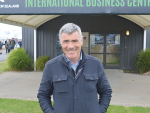
 Nathan Guy with plans for his new $2million double rotary shed.
Former Minister for Primary Industries Nathan Guy is heading back to his dairy farm in the Horowhenua with plans to invest more than $2 million in a new innovative dairy shed.
Peter Burke reports…
Nathan Guy is planning to build a twin rotary shed – meaning two, 50 bail rotary platforms in the same building, which will be capable of milking 700 cows in just one hour. The design is identical to the one built by his political colleague, former National MP and Taranaki dairy farmer Shane Ardern.
The new shed will replace two other milking sheds on the property, but Guy says they will still keep a small 28 bail rotary, which his father built in 1975 and that will be used for milking mainly the heifers on the property. His children have been involved in the decision making and are also excited about the future of the industry.
Guy believes now is a good time to invest in the dairy industry. He says interest rates are low and he hopes to have the new shed paid off in the next 10-15 years.
“We could have gone into bull beef or dairy grazing,” he told Rural News. “We’ve had deer in the past and some of the land around us is used for horticulture, but we are dairy farmers and proud of it and have hence decided to invest in the sector.”
Guy says the new shed will be ‘up-spec’d’ in terms of technology, with an automatic drafting machine and automatic cup removers. The plan also includes a system to recycle the water, which will reduce water requirements on the farm.
The soon-to-be former MP plans to milk a total of 1500 cows split into three herds of 500 cows through the twin rotary shed, which looks almost like two gigantic clocks running in synchronisation. The big efficiency comes when there is a constant flow of cows going through the shed. Guy says this means that staff will have to ensure that the cows are there waiting to be milked and that there are no delays in getting them to the shed. He says if there is a stoppage in the flow of cows and a machine has to be shut down, the efficiencies are lost.
“When they are going through the shed, cows from different herds will likely become mixed up with animals from other herds but this is where the automatic drafting system kicks in,” he explains. “As the cows leave the shed, a machine reads their ear tags and each animal is drafted back into its own herd again.”
Guy adds that milking the herds faster results in immediate production gains because the cows will be back on pasture quicker than they would in a normal situation. He also points out that staff will spend less time in the shed putting on cups and will be able to get out and do other work on the farm.
Cost wise, the decision to build a twin rotary shed system as opposed to building two stand-alone rotary sheds stacks up, according to Guy.
“We only need one effluent pond, one power supply and one tanker track to the shed. Also, when we start calving we may only run one rotary and potentially the same at the end of the season.”
Guy also has plans to install solar panels but concedes that they probably won’t generate enough power to run a shed of this size. However, it will save some money.
He is also taking the opportunity to improve the genetics of his herd, taking advantage of the good beef prices in China to get rid of poor performing cows.
In the meantime, Guy will be swapping his suit for farm overalls. But says he’s loved every minute of the 15 years spent in Parliament and says his dream job was being the Minister for Primary Industries.
His immediate focus is on the new shed and upgrading the farm. However, Guy admits that he’s also on the lookout for some sort of governance role in the primary sector. Rumours around Wellington suggest the dairy industry is an area of particular interest to him.
Speedy Ardern
Shane Ardern is perhaps best remembered as the MP who drove a tractor up the front steps of Parliament in 2003 in protest at the government’s so called ‘fart tax’.
But after leaving Parliament, he went back to his dairy farming operation in Taranaki and this year built what is said to be the fastest dairy shed in NZ. Faced with having to replace his aging shed he travelled the world to find the answer, which he found it in the USA – a twin rotary shed.
The twin rotary he’s had built consists of two 40 bail rotary platforms which enables him to milk his 600 cows in just one hour.
“Most of the modern sheds milk about 400 cows an hour and cost about half a million dollars more than mine. Most of the sheds suit the builders, the milking machine fitters and engineers but don’t suit the cows and the management of stock flow,” he told Rural News.
Ardern says for many staff, spending long hours in the milking shed is not something they like and is an inefficient use of labour. He says milking cows faster is a win-win for farmer and staff alike.
New Zealand’s red meat sector has welcomed the India-New Zealand Free Trade Agreement taking effect, which removes India’s 33% tariff on New Zealand sheepmeat.

New Zealand's role is not to compete with Indian growers, according to NZ Apples and Pears.
The red meat sector is in great heart.
As expected, the US has launched a safeguard investigation into lamb imports, a move that could impact New Zealand sheepmeat returns.
New Zealand's red meat sector says it welcomes the Government's focus on trade ahead of the general election in November.

In farming there are external factors that can influence behaviour of a whole herd, such as a bad weather event, triggering false positive heat detections or health attentions.
For Canterbury dairy farmer Cameron Henderson, supporting Meet the Need comes down to a simple question: how can the success of New Zealand farming benefit more than just those within the industry?
Fonterra board members are in line for a pay rise of around 3%.
Dairy processors are ready to further boost New Zealand’s export earnings but want the incoming government to match their ambition with good policy.
Massey University is best placed to solve the “problems” facing the dairy industry, says vice chancellor, Pierre Venter.
Synlait's longest serving employee – a man who joined the Canterbury-based milk processor even before it began processing milk – is now its newest executive.

OPINION: The same mainstream media muppets that brought you Jacindamania in 2017 have been flat out pimping for the Opportunities…
OPINION: Your old mate reckons the atrocious way farmers in the UK are treated by their lords and masters in…