NZ kiwifruit sector on alert for mysterious Italian disease
New Zealand's kiwifruit industry is on alert following reports of a mystery disease that is sweeping through Italian orchards.




 increase font size
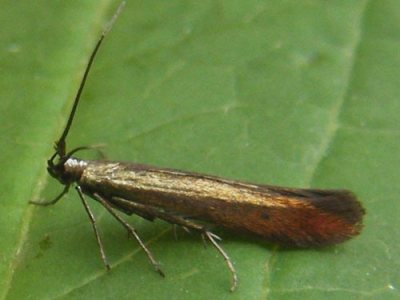 A red clover case bearer moth.
A red clover pest first formally identified in New Zealand 15 months ago has now been found nationwide.
FAR seed research manager Richard Chynoweth says the red clover casebearer moth (Coleophora deauratella) was discovered in Auckland in October 2016, setting off alarm bells and prompting nationwide monitoring.
Special pheromone traps were imported and distributed to red clover growers up and down the country during this summer’s clover growing and flowering period.
“Traps were placed on farms from the lower North Island to the south of the South Island,’ Chynoweth says.
“The results are not good news for red clover growers, with moths being found on farms, roadsides and other areas everywhere from Wairarapa to Southland.
“As it was first identified in Auckland, we can assume they will be found across the North Island as well. Given the numbers and spread of this pest, it seems likely to have been here for quite a while. I guess it’s been around for at least a decade and could have been affecting red clover seed yields for several years.”
Red clover casebearer is a small moth (about 8mm long) and is very similar to two other species of clover casebearer moth (Coleophora spp.) already well established in white clover in NZ, however in this case it’s principal host is red clover. Adult moths lay eggs on developing red clover flower heads and once hatched the larvae tunnel into the florets to feed, destroying the growing seed.
As the larvae grow, they stick onto a chewed-off floret, using use it like a cape for protection and camouflage. Feeding damage to seeds can severely impact crop yields.
Chynoweth says because little is known about red clover casebearer in NZ, researchers have a lot of work on their hands.
“We will continue to monitor its spread, but more importantly we need to understand its life cycle and exactly how that links with the red clover growth cycle. Once we have a clearer idea of that, we can start to consider control options, so that arable farmers can continue to grow this specialist crop.
“Late last year did initial laboratory insecticide trials and the results indicate that some insecticides currently registered for use in clover crops are effective against red clover casebearer moth. However, field trials will be required, as adult moths moving within the foliage of a growing crop may not receive a direct application due to location in the foliage. Further work will investigate whether any of the parasitoid species which already help to control other Coleophora spp. in white clover crops could be of use.”
In the meantime, farmers who wish to check their crops for the presence of red clover casebearer should inspect flowers looking for millimetre sized holes chewed into the base of individual florets and/or distinctive black droppings, also at the base of the florets.
They may also be able to see the case bearing larvae, which look like small red-brown cigars on the flowers. If evidence of casebearer is found, discuss management with a crop agrichemical advisor.
This work is done by FAR with support from the Seed Industry Research Centre.
New Zealand's kiwifruit industry is on alert following reports of a mystery disease that is sweeping through Italian orchards.

Could automated gun turrets in the bush shooting predators with poison paintballs rid the country of introduced pests?
As mealybugs gain a foothold in Central Otago, grapegrowers are being urged to be vigilant for signs of Grapevine Leafroll-associated Virus Type 3 (leafroll 3) in vines.
An invasive weed that can reduce water quality and block irrigation systems has been discovered in the Waikato River.
For strong wool sheep, lice infection is a nuisance more than a hefty financial cost. But, for fine wool sheep the financial toll is much greater.



Penske Australia & New Zealand has appointed Stephen Kelly as the general manager of its Penske NZ operations, effective immediately In this role he will oversee all NZ branch operations, including energy solutions, mining, commercial vehicles, defence, marine, and rail, while continuing to be based at Penske’s Christchurch branch.

According to the latest Federated Farmers-Rabobank Farm Remuneration Report, released today, farm worker pay growth has levelled off after a post-Covid period of rapid growth.
The Climate Change Commission has recommended maintaining the current New Zealand Emissions Trading System (NZ ETS) settings but warns of a potential unit shortfall as early as 2028.
The Conservative Party warns that the upcoming free trade agreement between New Zealand and India may prioritise increased labour mobility while offering limited reassurance for New Zealand workers.
Southland District Council says it is actively managing the impacts of the current fuel supply challenges to ensure essential services across the district continue to operate safely and reliably.
A large crowd turned out for the last of the field days of the three finalists in this years Ahuwhenua Trophy to determine the top Maori horticulture entity in Aotearoa New Zealand



OPINION: When Donald Trump returned to the White House, many people with half a brain could see the results for…
OPINION: Media trust has tanked because of what media's more woke members do and say.