Plug-and-play Kia
First came Kia Motors New Zealand’s launch of the Niro Hybrid and Plug-in Hybrid models in March, and now the company reports strong interest in the all-electric Niro EV recently unveiled in Korea.




 increase font size
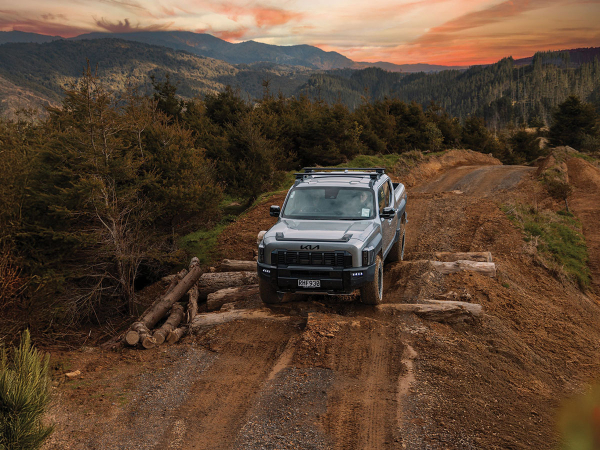 Kia is celebrating the arrival of its first ute - the Tasman.
Stepping into the already crowded ute market, it’s important to bring your best game. Kia look to have done just that with the arrival of its first ute, the Tasman, at a recent event in Wellington.
Its utilitarian looks make it stand out from the crowd, taking cues from the military vehicles Kia has built since 1973. It invariably draws comment like “looks that only a mother could love”, but in the flesh, that chunky, slab-sided look certainly grows on you.
Built on a ladder chassis and measuring 5.4m long by 1.9m wide, the Tasman lines up with its rivals from Ford and Toyota, offering a payload of 1025kg and a braked towing capacity that meets the industry standard of 3500kg.
Offered in five grades, the TX, TXR, TXS, X-Line and X-Pro are all configured with selectable 4WD with double-cab and well side layout, with single and double cab chassis option available later this year and early 2026.
Power in all models is delivered by a 4-cylinder, 2.2-litre turbodiesel, producing 154kW and 440Nm, mated to an 8-speed automatic transmission.
While the exterior looks might induce a Vegemite moment - you’ll love it or hate it - the interior will quickly be the benchmark that the rest of the industry will aspire to, with a combination of highquality materials, excellent fit and finish and well thought out layouts. Dual 12.3- inch screens - one for instrumentation and one for infotainment - also sees shortcut buttons for media and climate control.
Depending on the model, the front seats are cloth or faux leather, with the higher grades getting ventilation or heating, while the roomy rear space offers slide and recline for its occupants, alongside flip-up seats that reveal a large floor area for tools or supplies, with hidden storage cubbies under the base.
All models get LED lights, a trailer brake control system and terrain selection modes for mud, snow, sand and rocks. Higher grades get surround view cameras, alongside electro-mechanical rear diff locks, underbody protection, ground view cameras and enhanced off-road software.
Our short test in the hills east of Otaki consisted of muddy trails, rock-strewn ascents and descents, deep water-filled holes and multiple blind crests and tight turns. The Tasman certainly inspired confidence in its offroad abilities, with the X-Pro on test offering the choice of 2WD High/4WD High/4WD Auto and 4WD Low settings. Of particular interest, the X-Trac System – in effect an off-road cruise control feature – manages throttle and brake functions at speeds of up to 6km/h. In practice, once set, it meant the ute tackled the toughest inclines and difficult ground conditions with no need for any manual throttle input.
Depending on the grade, look out for the likes monitoring of tyre pressure and pitch & roll, parking sensors and an extensive range of around 150 New Zealand designed and manufactured accessories including snorkels (standard wading depth is 800mm), load bay securing systems and side steps.
Rural News looks forward to extended drive time in this serious market challenger in the coming weeks, so watch this space; rival manufacturers certainly will be!
First came Kia Motors New Zealand’s launch of the Niro Hybrid and Plug-in Hybrid models in March, and now the company reports strong interest in the all-electric Niro EV recently unveiled in Korea.
As the top selling model for Kia Motors, the arrival of the 2016 Sportage SUV is timely considering New Zealand's current love affair with this type of vehicle.
Kia has scored a triple triumph in one of the oldest design competitions in the world.
KOREAN CAR maker Kia claims a 480% jump in the value of its brand in seven years because of its R&D and marketing spend.
The ‘100 Best Global Brands 2014’ list values Kia at US$5.4b, up from US$929m in 2007.
THE UPDATED Kia Sportage is reported by the New Zealand distributor to have topped its class in a survey on owner satisfaction by influential JD Power automotive consultants, Germany.

Federated Farmers has welcomed new rural policies released by ACT, saying they align closely with its own election priorities.

Rural Contractors NZ says proposed changes to land transport rules for agricultural vehicles are a welcome response by the Government to out of date regulations which have seen members hit with huge fines.
Alliance is calling for final applications for its 2027 Graduate Programme, with applications closing on Sunday 25 October.
Decades piloting planes has ensured vet and farmer David Hayes is focused on safety. So, after a serious accident while welding on farm, he is sharing his experience so others can learn from it.
Canterbury milk processor, Synlait Milk has confirmed Leon Fung as its chief executive officer.
OPINION: Making it easier to collect rainwater and use it to grow crops and livestock is a no brainer.


OPINION: The same mainstream media muppets that brought you Jacindamania in 2017 have been flat out pimping for the Opportunities…
OPINION: Your old mate reckons the atrocious way farmers in the UK are treated by their lords and masters in…




