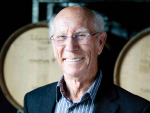
Wine giant Peter Babich farewelled
A “giant” of New Zealand’s wine industry was farewelled in February, with the passing of Peter Babich, aged 92.




 increase font size
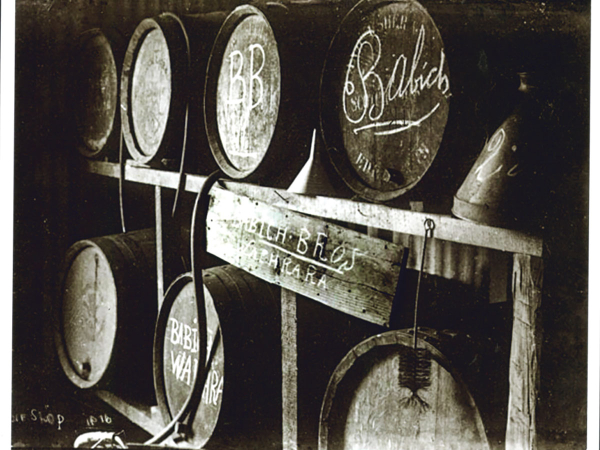 Wine barrels in the original tin shed winery at Kaikino, Northland.
Josip Babich made his first barrel of wine in Northland in 1916, aged 20, having immigrated to New Zealand to join his brothers in the gum fields. His grandson David Babich, Chief Executive of Babich Wines, looks back at one of New Zealand's oldest wine stories.
My grandfather Josip (Joe) was born in 1895 in what is now modern-day Croatia. Up until the end of WW1 it was part of the Austro Hungarian Empire. He was one of eight brothers born to my great grandparents, who were subsistent farmers, barely eking out a living on the tough, stony hill country of Dalmatia.
Understanding that there was no future for their kids in this economic, political and physical environment, my great grandparents made the difficult decision to send their sons to New Zealand, a country they knew little about, but which was described to them as offering good opportunity to those willing to work. From 1904 to 1910 they sent five of their sons here, borrowing money off the church to pay for the boat tickets. My grandfather, aged 14, was among the last two to go, and would never to see his parents again.
Joe and his brother Stipan (Steve) arrived in Auckland in April 1910 and made their way north to join their three older brothers in the gum fields. Prospecting for kauri gum gave the brothers enough cash to get by, while learning to speak English and to understand what opportunities existed in their new situation. In 1911, the brothers purchased a 30-hectare parcel of land in Henderson, West Auckland, which remains the headquarters of Babich Wines.
The brothers needed to continue earning money in the gum fields, as they knew breaking in the newly acquired farm would be financially taxing. It was during this time, in 1912, that Joe planted a vineyard on some government lease land at Waiharara, near the southern end of 90 Mile Beach. A few years later, when the (mainly) Isobella grapes were cropping, he gained his winemaker’s licence and began selling wine mainly to other Croatian gum diggers in the area.
From around 1919 the brothers began making trips south to Henderson to begin breaking in the farm. Thomas Henderson, namesake of Henderson township, had milled the property some 70 years earlier, and it was covered in regenerating bush. Joe described the 25 years from 1919 as remarkably difficult, as the farm teetered constantly on the edge of bankruptcy. He noted that over this period they were unable to reduce the principal owed on the farm by even one pound, and on several occasions he had to ask the private mortgage holder if he could add the interest owed to the principal.
This cashflow crisis continued until around 1943. At that time, United States soldiers fighting in the Pacific were on recuperation leave in New Zealand and one of the camps was nearby Redwood Park Golf Club. Amongst the soldiers were Mediterraneans – Italians, Greeks and I suppose some Croatians – and these soldiers wanted red table wine while on leave. So, to the winery they would head in their Willys Jeeps, purchasing wine and paying in US dollars. Joe said this ironic positive outcome of the war (ironic as wars deliver mostly negative outcomes) allowed some alleviation of debt on the farm and set the winery on a course of trending positive for cashflow.
Of the brothers, Jakov returned to Croatia in 1914, got caught up in WW1, survived it, though was badly injured, and died in 1919 of Spanish flu. He is buried in Runovic, the village the family is from. Mate stayed up north on the farm. Ivan was working on the Henderson property but died of pneumonia in 1922 and Stipan planted an orchard, while Joe stayed with the grapes.
In the late 1920’s Joe met Mara Grgic, recently from Croatia, and in 1929 they were married, going on to have two sons, Peter and Joe (jnr), and three daughters, Ivy, Shirley and Maureen. My father, Peter, was 16 when he joined the business in 1948, which I suspect was a real boost for my grandfather. Business was still very difficult, but dad was confident that they could make it work. At that time tractors were still uncommon and dad became competent running a two horse team (Bob and Trigger) to do vineyard operations such as discing or spraying. And indeed, times were changing, with an upswing in demand for wine from the late1940s onwards.
Joe, the youngest of the siblings, joined dad in 1958 and soon after took over the winemaking duties, going on to do more than 35 vintages as head winemaker and 35 years of national wine judging, including six years as chief judge in the national wine competition. Joe, along with Bruce Collard, was instrumental in setting up the export certification process that the industry required to protect our budding international reputation, which was vulnerable, especially in the early years.
My own recollections of the winery started around the early 1970’s, when I was aged around four years old. At that time, all of our grapes were grown on the Henderson vineyard. Grapes were hand harvested into wooden boxes, which made their way to the winery by tractor to be tipped by hand into a crusher/destemmer. I suspect a normal vintage would have been 60 to 80 tonnes, and it required a lot of manual work to process that volume.
In 1980, a German visitor turned up at the winery, tasted the wines, and asked if he could make arrangements to export our wine to Europe. He paid upfront, a 20 foot container was loaded, and Babich Wines was in the export business. Dad and Joe put a lot of effort into growing exports from 1980 onwards, but it still took
until 1997 before exports exceeded domestic sales.
Dad invested a lot of time into assisting with industry growth and industry issues, having served decades on the Viticultural Association and then the Wine Institute (the pre-cursor to New Zealand Winegrowers). A famous photo, taken at our Orewa beach house in 1991, captures the Institute planning meeting where the target of $100 million of export receipts by the end of the decade was set. The target was achieved and by the turn of the decade (and century) export sales were at $125m for the industry.
Dad and Joe knew the business needed to keep changing to stay relevant. In the late 1980s the international interest in Marlborough Sauvignon Blanc became too loud to ignore. Our first experience with Marlborough was to purchase some Sauvignon Blanc juice as it seemed impossible to acquire the same as grapes. The resultant wine won a few international awards and our distributors wanted ten times what we could supply. Dad started cold calling farmers-turned-grape growers in Marlborough and managed to convince a young Murray Gane to grow some grapes for us; his neighbour David Pigou was close behind. Peter Rose and (the late) Jim Rose joined this small group of growers a few years later.
Through the 1990s it was a common thread of discussion to consider whether the music would stop on Marlborough Sauvignon Blanc. We know now that it didn’t, but that wasn’t at all clear at the time. Demand from distributors continued to grow and like many we struggled to supply. We purchased our first Marlborough vineyard, Wakefield Downs in the Awatere Valley, in 1997, and kept up a steady stream of vineyard acquisitions and developments over the following 25 years. We also invested in winery infrastructure to process the grapes and make the wine, before sending it north to Henderson for bottling.
The impact of Marlborough Sauvignon Blanc on our industry and on our own business has been nothing short of remarkable. My grandfather Joe died in 1984, and I often reflect on how he missed seeing “what happened next”.
Like my brothers and cousin André, I grew up on Babich Road, and the winery and vineyard were the playground. I was interested in winemaking, so once I completed high school, I headed off to Australia to do the Roseworthy College Bachelor of Applied Science in Oenology. This was in 1987, before a winemaking qualification was available in New Zealand, so it was where all the budding Kiwi winemakers went. I survived (it was reasonably wild in the late ‘80s) and came home to commence work in the winery, which I did mainly dragging hoses around for a couple of years. I determined that I should go back to university (Auckland) to study commerce and eventually re-enter the company, but on the business side. This took a while, as following completion of the degree I landed a job in pharmaceuticals. Seven years later, with considerably more experience, I rejoined the business and started to learn how this place ticked.
Working with Dad and Joe was great. There was none of the succession angst that can occur in a business undergoing generational transition. They were constantly handing responsibility over but were always there for guidance. The transition from them running the business to me running it was so smooth that I hardly noticed, but by 2010 it became apparent (to me) that I was in charge.
There has been a remarkable amount of change over the past 25 years; of course, the scale of business has changed and the number of markets we sell to has grown. In 2018, my cousin André (Joe’s son) stepped away from a couple of decades of investment banking to join us in the business. Briefly there were four Babich family members involved and we had a broad cross section of skills and experience. This came to an end with Joe losing a battle with cancer in 2022 and Dad ultimately succumbing to a head injury following a fall, passing away in 2025. Collectively, they had actively served the business for 135 years and were in the front row to see the transition of our industry from the old industry to the modern one.
In spite of a lot of current headwinds, we remain positive about our fortunes and those of our industry, and we look forward to continuing growth. There are early signs of additional family involvement as well, with my son Peter recently completing a second winemaking vintage in Marlborough as he studies towards a Bachelor of Commerce.
A “giant” of New Zealand’s wine industry was farewelled in February, with the passing of Peter Babich, aged 92.
Craigmore Sustainables has added to its viticulture portfolio with the purchase of a 418-hectare development site in Marlborough.
Babich Wines is sponsoring the Sustainable Coastlines Trust to support communities around New Zealand to clean and protect local beaches and waterways.
Petar and Iva Babić are the “heroes” of the Babich Wine story, having sent six of their seven young sons to forge a life in New Zealand.
After more than a century making great wine, Babich Wines has begun to harvest its stories as well.


One of Australia's most decorated winemakers will speak at the Aotearoa New Zealand Chardonnay Symposium in Hawke's Bay this September.
The third Aotearoa New Zealand Chardonnay Symposium will be underway in Hastings, Hawke's Bay, on 17-18 September.
In early May, New Zealand Winegrowers delivered a webinar for members, providing a commercial view of New Zealand wine in…



